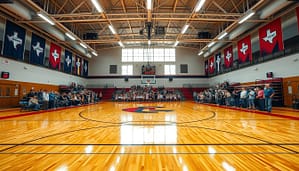
Forget what you’ve heard about March. While others focus on a certain other bracket, we have our own excitement here. It’s not about Cinderella stories but about our community’s roots.
The UIL state championship is more than a sports event. It’s a tradition that holds our towns together. In Martin’s Mill, a small town, the community celebrated a big win. Their boys’ and girls’ teams both won, a tradition that goes back to 1949.
The parade wasn’t just for the players. It was a celebration of hope and hard work. It showed the community’s dedication and joy.
This is where the magic truly happens. The tournament turns individual efforts into a strong sense of community pride. It’s not just about winning, but about who we become together. The journey is as important as the destination.
Historic venues from Gregory Gym to Alamodome championship game evolution
The move from Gregory Gym to the Alamodome is more than a venue change. It’s a cultural shift. The Alamodome tells the story of Texas’s growth and ambition.
Gregory Gym was more than a place; it was a tight space. You could smell the liniment and hear every sound. It felt like the whole town was watching, holding its breath together.
The game was close and raw. It felt human-sized.
As Texas grew, so did its dreams. Moving to bigger arenas was a statement. It wasn’t just about more seats. It was about creating an event, not just a game.
The Alamodome changed the game. The sounds were lost in the vastness. What was once a secret became a broadcast for all to see.
But the stakes grew even higher. The stage was huge, making every shot seem both small and huge. The pressure was now on a grand scale.
| Venue Characteristic | The Gregory Gym Era | The Alamodome Era |
|---|---|---|
| Atmosphere | Intimate, electric, communal. A town secret. | Grand, spectacular, corporate. A broadcast event. |
| Scale | Human. You could see the sweat. | Epic. The court seems a distant island. |
| Audience Experience | Participant. You felt every play in your bones. | Spectator. You witness a large-scale production. |
| Sensory Details | The smell of polish, the sound of a specific squeak. | The hum of AC, the glow of Jumbotrons. |
| Cultural Metaphor | The close-knit Texas town. | The ambitious, modern metropolis. |
Every championship game highlight is seen differently now. A winning shot in Gregory Gym was loud and clear. In the Alamodome, it’s a silent shot followed by a loud cheer from thousands.
So, is it progress or loss? It’s both. We’ve moved from small stories to big ones. Looking at this change helps us understand Texas’s growth. For more on this journey, check out a detailed history of the UIL Texas boys state. The floors have changed, but the dreams remain the same.
David vs Goliath moments small town schools defeating powerhouse programs
These aren’t just lucky wins. They’re bold challenges. When a small school beats a big city team in Texas UIL, it’s a big deal. It shakes up the state’s power balance.
The strategy is clever. Coaches spend months finding a hidden weakness in the big team. They plan a precise attack, not just a random shot.
Defensive tactics are key. You can’t outplay the big team, so you outlast them. The small school’s defense is intense, making every play a battle.
The team’s confidence is what sets them apart. They believe they can win, even against all odds. This belief is their secret weapon.
These moments are legendary. They’re the championship game highlights that fans remember for years. A guard from Rule scoring 40 points against a Dallas team is a story told in diners.
These wins are a big upset. For a weekend, the big schools are ignored. The map of Texas basketball changes, showing that small towns can compete.
These upsets are the heart of the tournament. They show that hard work and unity can beat talent. Each clutch shot in these championship game highlights is a vote for the sport’s true spirit.
Individual brilliance record setting championship performances and clutch shots
Forget the ‘team effort’ talk for a moment. The UIL tournament loves the solo act. We all love a team working together, but we live for the moment one player shines. This is where personal legend meets public record.
These aren’t just good games. They are so outrageous, they feel like a glitch in the matrix. Imagine a kid scoring 50 in a title game or posting a triple-double. These legendary performances don’t just win a trophy; they change what we think is possible at the high school level.
Then there’s the clutch shot. It’s the holy grail of individual sports. Why? Because it’s a narrative atom bomb. That hanging jumper as the buzzer blares does more than add two points. It instantly rewrites a player’s biography and etches itself into a town’s permanent memory bank.
The analysis here is delicious. The clutch shot is the ultimate fusion of skill, nerve, and destiny. It’s a player screaming, “This moment is mine,” and an entire community getting to claim a piece of that forever. It’s personal excellence weaponized for communal glory.
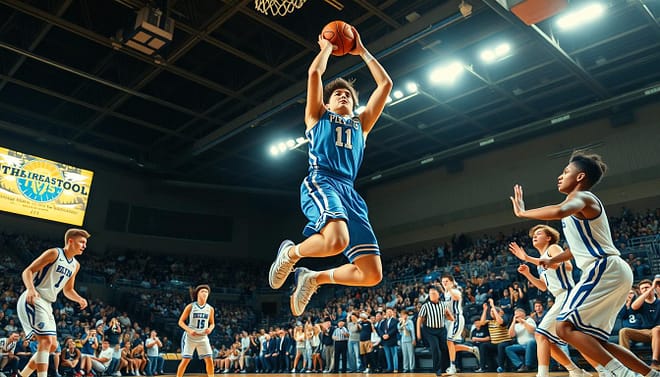
Let’s get specific. The history of the UIL state championship is dotted with these singular explosions of talent. They become the benchmarks against which all future greatness is measured.
To understand the scale, look at the data. The table below isn’t just a list of stats. It’s a shrine to individual audacity on Texas’s biggest stage.
| Player Name | School | Year | Championship Stat Line | The Legendary Note |
|---|---|---|---|---|
| JaKobe Coles | Denton Guyer | 2020 | 47 points, 8 rebounds | Set the Class 6A championship game scoring record in a dominant title win. |
| Tyrese Maxey | South Garland | 2019 | 42 points, 6 assists | MVP performance fueled by explosive scoring, leading his team to the state title. |
| Greg Brown III | Vandegrift | 2020 | 30 points, 20 rebounds | A monstrous double-double that showcased sheer physical dominance in the paint. |
| Darius McBride | San Antonio Wagner | 2018 | 15 points, 10 rebounds, 12 assists | A rare championship game triple-double, mastering every facet of the game. |
| De’Aaron Fox | Cypress Lakes | 2016 | 38 points, 8 steals | Blistering speed and defensive terror translated into a legendary two-way performance. |
What makes these lines so captivating? They represent a player not just participating in history, but forcing it. In a system designed to crown teams, these individuals become unavoidable headlines.
The clutch shot operates on a different frequency. It’s less about cumulative stats and more about a single, seismic point in time. It’s the three-pointer that silences a rival’s comeback. The driving layup through contact as the clock hits zero.
That shot becomes a story told at diners and reunions for decades. “I was there when…” The player’s name becomes a verb in that town. To “pull a [Player’s Name]” means to deliver under impossible pressure.
This is the raw magic of the UIL state championship stage. It provides the pressure cooker where individual brilliance can achieve its purest, most unforgettable form. These legendary performances are the exceptions that prove the rule. They remind us that while basketball is a team sport, its most enduring myths are often written by one.
Coaching legends who built championship programs and developed winning cultures
Forget the buzzer-beaters for a second; the real magic trick in Texas high school hoops is a coach building a culture that lasts half a century. The star player is a comet—brilliant, then gone. The legendary coach is the gravity that holds the solar system together. Their job isn’t just to diagram plays; it’s to engineer an ecosystem where winning becomes the weather.
This is the sage in a polo shirt. Their brilliance is in cultural engineering. They don’t just install a playbook; they install a standard. A standard that says how you practice on a Tuesday in January matters as much as the championship game in March. Look at a program like Martin’s Mill. Their first title came in 1949. Their latest came decades later. That span isn’t a coincidence; it’s a curriculum.
What’s the playbook for building a century? It’s less about a secret press break and more about building an institution. These coaches are architects. They lay a foundation of discipline, effort, and collective belief so strong that player turnover can’t crack it. The system itself becomes the star.
This deep work is the bedrock of Texas basketball history. The trophies are the visible peaks, but the coaching legends are the tectonic plates below. They teach kids how to win, absolutely. But their masterstroke is teaching a town how to expect it. They transform hope into habit. That’s where genuine community pride is forged—not in a single parade, but in a perennial identity.
The table below breaks down the blueprint of these dynasty builders. It’s not a list of drills, but a manifesto for lasting impact.
| Coaching Trait | What It Builds | On-Court Manifestation | Texas Example |
|---|---|---|---|
| Cultural Engineering | An immutable program identity. “This is how we do things here.” | Consistent defensive intensity and unselfish ball movement, regardless of personnel. | Programs with multi-decade success, where the style of play is recognizable year after year. |
| System Over Stars | Sustainable success. The offense doesn’t leave when the leading scorer graduates. | Role players excel because they understand their function within a coherent scheme. | Teams that remain competitive even in supposed “rebuilding” years. |
| Developmental Pipeline | A legacy of players. JV isn’t just a team; it’s a training ground for varsity mentality. | Seamless transitions where new starters play with the poise of veterans. | Small-town schools that consistently produce college-level talent. |
| Community Ambassador | Deep-rooted community pride. The team is a civic institution. | Packed gyms for every game, creating a tangible home-court advantage. | Programs where the coach is a local fixture, connecting with generations of families. |
So, while we celebrate the player who hits the shot, we must venerate the coach who built the stage. They are the stewards of tradition. They write the invisible rulebook that governs effort, attitude, and expectation. Their win-loss record is just the headline; their real product is a winning culture.
That culture becomes the town’s heirloom. It’s a shared belief passed down, a piece of Texas basketball history that feels personal. The coach, in the end, doesn’t just build a program. They help a community build a better story about itself.
Community rallying championship runs that united entire towns and regions
When a high school basketball team wins, it changes a town. It’s more than a sports story; it’s a big event for everyone. It brings people together, making the town feel like one big family.
Politics and age differences fade away. The town comes together, united in hope. The diner becomes a place for planning, and the pharmacy shows off team photos. It’s all about community pride.
Take Martin’s Mill as an example. Their parade was for everyone, not just the players. It was a celebration of the town’s spirit. The whole town came out, united in their support.
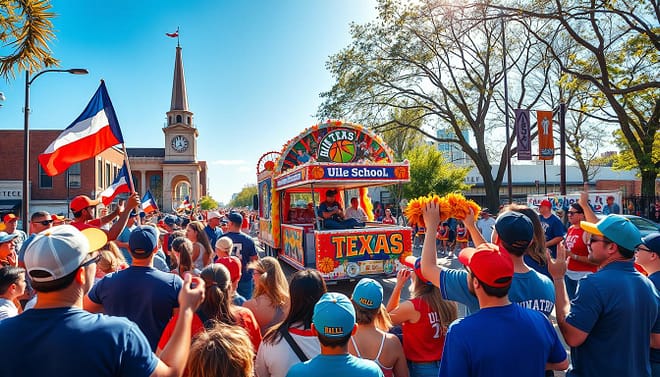
This unity is amazing. It shows that even sports can bring people together. The team’s success makes everyone feel connected, putting aside differences.
So, what does this unity look like?
- The Business Boost: Restaurants and shops become fan zones, filled with game schedules and posters.
- The Communal Nervous System: News spreads fast, through texts, social media, and talking to neighbors.
- The Shared Vocabulary: Strangers easily start conversations about the game.
The trophy is a symbol of victory. But the real treasure is the memories of unity. It’s the feeling of being part of something bigger than ourselves.
Winning a UIL state championship is more than a trophy. It’s about the moments shared along the way. It shows that community is built on shared goals and dreams.
Overtime classics multiple overtime thrillers and dramatic finishes in title games
Overtime is like a knife fight in a small space. The game becomes intense, with every play feeling like a big challenge. It’s when the usual game plan goes out the window, and we get to see real, raw drama.
Games that go into multiple overtimes are truly unique. They’re not just sports anymore. They test players’ endurance and mental strength. It’s not about the usual strategies, but about who can keep going the longest.
Each extra period makes the game simpler. Coaches’ plans are just suggestions. It’s all about who wants it more and can keep going despite the exhaustion.
These games are unforgettable because they defy time. We expect 32 minutes of basketball, but we get so much more. It’s a bonus episode of human drama.
In overtime, it’s not just about winning. It’s about not losing. The fear of missing a shot becomes a huge factor. This creates unforgettable moments, like a steal from a tired player or a put-back from a center who acted on instinct.
These games show us the true character of the players. We see who can handle the pressure and who can’t. It’s a mix of awe and schadenfreude. We watch players pushed to their limits, and we see who holds strong.
These moments define legendary performances. It’s not about big scores, but about the will to keep going. These games are what make state tournament lore so special.
The drama in overtime games is unmatched. It’s the same excitement that makes us debate the greatest NCAA tournament games. When the clock stops but the score is tied, the game becomes unpredictable.
The legacy of an overtime title game lasts forever. It’s not just about who won, but how they won. The story is about survival, and that’s the most compelling part of any championship game.
Dynasty builders programs that sustained championship excellence across decades
Forget the one-hit wonders. The true architects of Texas basketball history are the programs that treat championships as a renewable resource. A single title is great, but a dynasty is more. It’s like the difference between a summer storm and the Gulf Stream.
So, what’s the secret sauce? It’s not just talent, though that helps. It’s institutional memory. Players arrive knowing the playbook and the expectation. These programs reload, not rebuild. Excellence is not whispered; it’s screamed.
Consider Martin’s Mill. Their resume is a timeline of Texas basketball history, with titles from 1949 to today. For a small school, that’s not just success; it’s a small-town empire. They are the Sith Lords of the hardwood, operating on a different, more patient plane. Their secret? Excellence is tradition, not a target.
The blueprint for these empires is deceptively simple, yet brutally hard to copy:
- The Pipeline: A consistent flow of talent, often homegrown, nurtured in a system that values the program over the individual.
- The Standard: A non-negotiable culture of winning. Losing isn’t a tragedy; it’s a betrayal of the legacy.
- The Memory: Coaches, players, and even fans serve as living historians, passing down the lore and the lessons.
This isn’t exclusive to rural powerhouses. Metro-area giants operate with the same ruthless efficiency. They turn the UIL state championship podium into a second home. Their dominance shifts the entire narrative of the tournament. They become the benchmark, the final boss every Cinderella must face.
The impact is profound. These dynasties don’t just win games; they shape the very identity of the UIL state championship. They force every other program to ask a painful question: are we building for a moment, or for a century? In doing so, they elevate the entire competition, turning March madness into a masterclass in sustained excellence.
Cinderella stories unexpected championship runs from unlikely schools
The most exciting story in Texas high school basketball isn’t made by Hollywood. It’s written by schools with little money and unknown teams. This is the Cinderella story, the tournament’s most thrilling tale. We all secretly hope for it because it shows that sometimes, justice is fair.
An “unlikely school” is more than just a small enrollment. It’s about a school with no trophies, a budget from bake sales, or being unknown. Their journey starts with a simple “what if?” Each win is a big deal, making everyone believe in the impossible.
The first big upset is like a wake-up call. It brings out community pride. Car dealerships change their signs. The local paper runs out of ink. Suddenly, a small town becomes the hero of a story everyone wants to follow.
What makes a Cinderella team different from a top team? It’s not just about talent. It’s about the whole team’s spirit and identity.
| Factor | Tournament Titan (Powerhouse) | Cinderella Contender (Underdog) |
|---|---|---|
| Program History | Legacy of titles; pressure is to maintain dynasty. | Legacy of participation; pressure is to make history. |
| Community Expectation | Championship or bust. A celebration deferred. | Each win is a bonus. Pure, unadulterated joy. |
| Statewide Recognition | Feared and analyzed. The known quantity. | Mysterious and romanticized. The fascinating unknown. |
| Path to the Title | A coronation march, navigating a target on their back. | A guerrilla campaign, stealing momentum and shocking giants. |
| Defining Legacy | Adds another chapter to an epic novel. | Creates a founding myth that fuels future community pride for decades. |
Take Martin’s Mill in 1949. Their first championship was more than a win; it was a foundational Cinderella story. For that community, it created a myth. It showed that even the most unlikely can achieve greatness. That single trophy told kids for generations, “This is possible for us.” It’s the ultimate story of overcoming odds.
These runs are celebrated for legendary performances that become local legends. The point guard who played on a sprained ankle. The sophomore who hit a buzzer-beater in the regional final. These aren’t just stats; they are stories passed down. They prove that anyone can make it big if they’re brave and talented enough.
Cinderella stories are essential. They are the heart of the tournament. They remind us that greatness isn’t just for the favorites. It’s for the team nobody expected, fueled by determination and legendary performances that live on long after the season ends.
Modern era evolution how social media and recruiting changed championship dynamics
The final buzzer sounds. Before the net even stops swaying, the clip is already trending. Welcome to the new chapter in Texas basketball history, where the game is played on hardwood and in the hashtags.
Social media turned a kid’s championship game highlight into a viral sensation before he wiped the sweat from his brow. That game-winning three? It’s a GIF, a meme, a digital monument. The community celebration now happens globally in real-time.
Recruiting is the other seismic shift. It’s a national, year-round spectacle. A single commitment from a five-star prospect can rewrite a program’s destiny overnight. The pressure is immense, the spotlight unforgiving.
Is this evolution good for the soul of the game? The essence remains—the heart, the hustle, the hometown pride. Yet, these elements are now broadcast, dissected, and debated on a national stage. Every dribble is data; every shot is social content.
The modern era adds layers of complexity to the legend. The championship dynamic is no longer confined to a gym. It’s a node in a endless conversation. The stories in Texas basketball history are now written in tweets and streams, forever archiving the new generation of championship game highlights.