
Welcome to the thunderdome, Texas-style. Forget the sterile, corporate feel of a national bracket. Here, the road to glory is paved in the cracked asphalt of local rivalries and the echoing squeak of sneakers in packed, humid gyms.
This is your orientation to the unique, often byzantine, world of the state’s UIL districts. We’re pulling back the curtain on the machinery that makes this initial crucible of conference play more than a schedule. It’s a cultural and competitive gauntlet.
Think of it as the political primary season for hoops. Messy, deeply personal, and absolutely essential for anyone with state championship ambitions. Success here is the first, non-negotiable chapter in any dynasty story. Consider how rule changes, like the adoption of the three-point shot in the historic 1988 season, reshaped the very fabric of this gauntlet.
This is where dreams are forged, and pretenders are exposed. Let’s analyze how.
Understanding the Texas Conference System
The Texas conference system is not chaotic. It’s a well-designed system of competition. It starts with a simple idea: to find a true state champion, you must first win in your area. The University Interscholastic League (UIL) is the mastermind behind this setup.
Classification is key. Schools are divided into six groups—1A through 6A—based on student enrollment. It’s like a weight class in boxing, but for whole communities. A 1A school might have 200 students, while a 6A school can have over 3,000.
The UIL divides the state into districts every two years. These districts are based on geography and zip codes. It’s not just about where you are; it’s about who you are up against.
The district tournament is the first big test. If you do well, you move on to the postseason. But if you don’t, your season ends. It’s that simple.
The path to the championship is clear: District Tournament -> Regional Tournament -> State Tournament. Your district performance sets your seeding. This can greatly affect your chances in the tournament.
| UIL Classification | Enrollment Range (Approx.) | School Setting & Scale | Tournament Dynamic |
|---|---|---|---|
| 1A | Up to 229 | Smallest towns, often rural; multi-sport athletes are the norm. | Community-centric; travel can be extreme; a true Cinderella story factory. |
| 2A | 230 – 484 | Small towns & rural communities; tight-knit fan bases. | High-stakes local rivalries define the early tournament rounds. |
| 3A | 485 – 1,159 | Larger towns & small cities; beginning of greater specialization. | A competitive sweet spot where depth starts to separate contenders. |
| 4A | 1,160 – 1,849 | Suburban & mid-sized cities; dedicated facilities and programs. | Strategic complexity increases; seeding is absolutely critical. |
| 5A | 1,850 – 2,219 | Major suburban powerhouses; often feeder schools for college recruits. | National-level talent within a hyper-local tournament format. |
| 6A | 2,220 & Above | Largest urban & suburban megaschools; resources akin to small colleges. | The big business of Texas HS sports; the ultimate championship path is a gauntlet. |
Is there a method to the madness? Yes, there is. The district tournament is a test of your entire season. One bad night can end your dreams. The championship path is filled with moments of truth.
Knowing this system is key. A loss in December can affect your chances in February. The UIL’s tournament format tests skill, consistency, and resilience. It’s the beauty and cruelty of the Texas conference system.
District Tournament Format and Rules
In Texas high school sports, the district tournament is a level playing field. It mixes the detailed records of conference play into a high-stakes event. Teen athletes become local heroes or cautionary tales in this intense weekend.
The University Interscholastic League (UIL) sets the rules, usually a single- or double-elimination format. Your entry is based on your regular-season performance in your UIL districts. Your wins and losses decide your seeding. The top seed has an easier path, while lower seeds face tough opponents from the start.
This seeding process often sparks heated debates. The biggest argument is about where teams play. Is it fair for the top seed to host every game? Does the home crowd’s support give an unfair advantage, or is it a reward for conference play success? Coaches and parents have debated this for years.
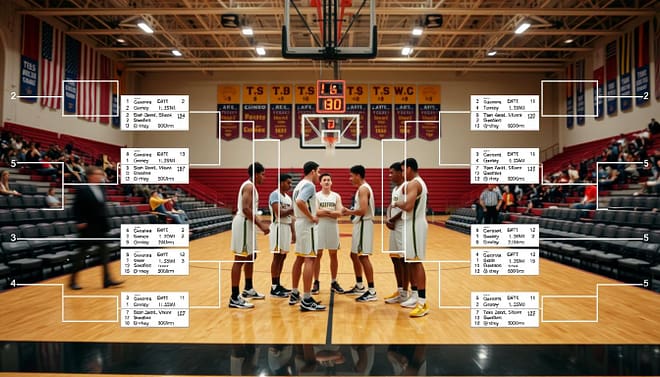
The rules are simple: win or go home. This adds a unique pressure. A single mistake can end a season. For seniors, it can end their career. It tests skill and nerve, turning athletes into clutch performers.
Coaches face tough decisions, like whether to rest stars or chase momentum. If you’ve secured the top seed, do you avoid injuries or keep the momentum going? There’s no right answer, only consequences.
Rematches add a psychological twist. Beating the same team for a third time is extremely challenging. The opponent knows your strategies. It becomes a mental battle of adjustments and willpower. The team that lost before often plays with a fierce, liberated spirit.
The district tournament is a unique mix of strategy and execution. It takes the season’s story and turns it into a dramatic climax. Here, championship dreams are shaped, one game at a time.
Strategic Importance of Conference Play
The idea that a team can suddenly improve in the playoffs is a myth. It’s like believing in fairy tales. The truth is, the path to the championship is a long journey. Conference play is the tough practice that prepares teams for the big games.
Why does this early-season grind matter so much? It shapes a team’s identity. A non-conference game is like a one-night stand. But district games are like a long-term relationship. You face the same challenges every night.
This process exposes your weaknesses and strengthens your strengths. It builds something valuable: competitive maturity.
This maturity is the real lesson. It’s not just about the game plan. It’s about dealing with the pressure and politics of a tight race. Boys become men in these challenges. Good teams learn to win under pressure.
The resilience built in conference play is tested in the tournament format. Playoffs are unpredictable. A team not battle-tested will struggle. They haven’t learned to win when it matters most.
Let’s look at the difference between conference and non-conference play.
| Aspect | Conference Play | Non-Conference Play |
|---|---|---|
| Competitive Intensity | High-stakes, familiar foes with deep scouting reports. Every game impacts standings. | Variable intensity; often used for experimentation or showing off talent. |
| Schedule Consistency | Grinding, predictable rhythm of back-to-back games against known styles. | Inconsistent, sporadic matchups that don’t simulate playoff weekly rigor. |
| Psychological Pressure | Constant, building pressure from local rivals and community expectations. | Generally lower; losses are easier to rationalize and move past. |
| Identity Formation | Forces teams to discover and solidify their true, resilient character. | Allows for facade-building against less-motivated opposition. |
| Playoff Preparation | Directly simulates the win-or-go-home mentality and format of the postseason. | Poor simulation; fails to prepare teams for single-elimination pressure. |
The right column is a mirage. A great record there is like a sandcastle. The first playoff round will wash it away. The left column is the foundation. Conference play is the map through the maze of the championship path.
So, can a team just flip a switch? No. The switch is built, wire by wire, during those cold Tuesday nights in Podunk, Texas. The playoff run is just the moment you turn on the lights. The brilliance of that light depends on the work done in the dark of the district season.
Memorable Conference Tournament Moments
Forget the state finals; the real legends are forged in the crucible of district playoff chaos. While championship rings gather dust in trophy cases, the stories born in the sweaty, deafening gyms of UIL districts tournaments live on. They are told in diner conversations and local newspaper archives.
This is where analysis gives way to anthology, and data points transform into dopamine-fueled community myth. It’s a place where heroes are made, not just in wins, but in the journey itself.
Every system needs its folklore. In Texas, that folklore has a distinct smell—a blend of popcorn, floor wax, and adolescent desperation. A single week of conference play can generate enough dramatic material to fuel a decade of reunions. Why? Because the stakes are hyper-local, and the heroes are the kids from down the street.
Consider the archetypal last-second shot. We’re not talking about a professional arena with 20,000 fans. This is a bandbox gym in a town you’d miss if you blinked. The ball arcs, the buzzer sounds, and a silence hangs for a millisecond before the roof nearly blows off.
That shot doesn’t just win a game; it etches a player’s name into the permanent record of a place. It becomes the answer to “Where were you when…?” for hundreds of people.
Then there are the Cinderella stories. The beauty of the UIL districts setup is its inherent capacity for chaos. A tiny 2A school, with a roster full of farm kids, can topple the perennial powerhouse from the big city in a neighboring district.
These upsets aren’t just statistical anomalies; they’re narrative grenades. They prove that on any given night, in any given hotbox of a gym, the script can be ripped up. The underdog’s victory tour becomes a shared point of pride for an entire community, a temporary rebellion against the established order.
Individual heroics reach mythic proportions here. A player scoring 40 points on a sprained ankle, a goalkeeper saving three penalty kicks in a shootout—these performances are whispered about for years. They’re the stuff of local ESPN highlights that get passed around on phones until the video degrades.
For the athlete, a legendary conference play tournament can be a life-altering catapult. College scouts, who might never have visited Podunk High, suddenly have a name on their radar. A scholarship offer can hinge on one transcendent week in February.
The impact radiates far beyond the court or field. A deep tournament run can temporarily suture a town’s divisions. Rival businesses put up supportive signs, the local radio station does live broadcasts, and for a few weeks, everyone is united under the same banner.
It creates a shared emotional vocabulary—a “remember when” that bonds generations. The players themselves form a lifelong fraternity, linked by an experience of collective pressure and euphoria that adult life rarely replicates.
So, while we can dissect brackets and debate seeding procedures, the soul of this system isn’t in its structure. It’s in the raw, human drama it reliably manufactures. The Texas high school conference tournament is a factory for Shakespearean plots, complete with tragic flaws, heroic arcs, and comedic relief—all played out by teenagers in polyester uniforms.
The trophies may tarnish, but the stories, born from the unique pressure of conference play, become permanent local history.
Coaching Strategies for Tournament Success
The district tournament is not just about talent. It’s a test of a coach’s hard work all season. Drills, film study, and conditioning are put to the test in a tournament format that’s all about winning.
The regular season is like a marathon, where mistakes are okay. But the playoffs are a sprint, where every play matters. The best coaches use this to their advantage.
Managing fatigue is a big challenge. You might face three games in three nights. You have to decide if to play your best players or save them for later. It’s a tough choice.
The coach who wins often isn’t the one with the best players. It’s the one whose bench players can step up when needed.
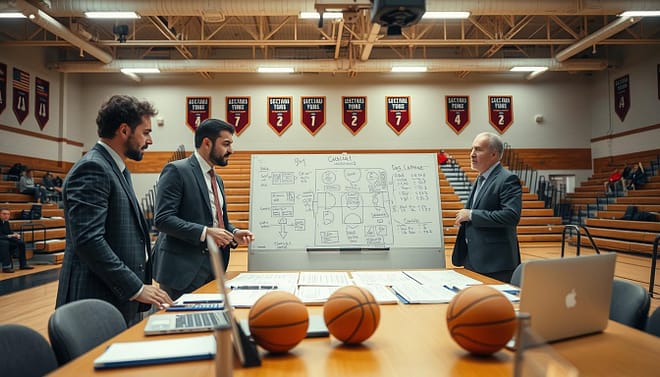
Playing a team you’ve seen before is like a chess match. You know their moves, and they know yours. The key is to come up with a new strategy quickly.
It’s not about introducing a new play. It’s about making small changes to your game plan. This is where a coach’s clipboard becomes a powerful tool.
Psychological games are just as important. A speech in February is about effort. But in a big game, it’s about who you are as a team. Timeouts are critical, deciding when to push or when to pull back.
Every decision is huge in a single-elimination game. You have to choose when to go for your star player or when to use a different strategy.
The best coaches see the tournament as a chance to learn. It tests your team’s strength in different situations. Losing can teach you more than winning easily.
To succeed in the tournament format, you need to be focused on the game and think about the future. The coach who can do both is on the path to success.
Player Development Through Conference Competition
Forget the anonymous travel ball tournaments. The most authentic player development happens when you defend your school’s colors in packed hometown gyms. While AAU offers glossy showcases, the real crucible of a Texas athlete is the night-in, night-out grind of UIL districts competition.
Think of it this way. An all-star camp teaches you to play basketball. Conference play teaches you to win basketball games. There’s a monumental difference.
The physical toll alone accelerates growth. You don’t get to rest your legs for a week after a bad performance. The UIL districts schedule is a merciless teacher. You learn to play through fatigue on a Tuesday, then do it again on Friday. This builds a type of endurance that weekend warriors never develop.
Then there’s the pressure. It’s one thing to play for a random team name on your jersey. It’s entirely different to represent your community, your friends in the stands, and the legacy of your school. Every defensive lapse feels personal. Every big shot echoes through hallways for days.
This environment forges basketball IQ at an exponential rate. Opposing coaches in your district study you. They design entire defensive schemes to stop you specificially. You learn to read double-teams, find cutters, and make decisions under duress. These are skills no pickup game can teach.
The resilience built here is the non-negotiable currency for any championship path. You learn to bounce back from a brutal loss because you have to face another rival in 48 hours. This mental toughness separates playoff performers from regular season stars.
For the college prospect, conference game film is their most honest resume. Recruiters don’t just watch highlights. They watch how you react when your shot isn’t falling. They see if you play defense when tired. The UIL districts stage provides this unvarnished truth.
But here’s the beautiful part. This system isn’t just for future stars. The role player finds their moment here, too. The championship path is paved by unsung heroes. A single defensive stop in a district tournament can make a legend. A critical rebound in a packed gym creates a memory that lasts a lifetime.
The development outcomes between the showcase circuit and genuine conference play aren’t just different. They’re fundamentally opposed in what they value and produce.
| Development Factor | AAU/Showcase Circuit | UIL Conference Play |
|---|---|---|
| Competitive Context | Low-stakes exhibition games | High-stakes rivalry with playoff implications |
| Defensive Focus | Individual matchups, often lax | Team-oriented schemes designed to stop you |
| Consistency Demand | Sporadic weekend tournaments | Night-in, night-out grind, often fatigued |
| Pressure Environment | Anonymous venues, neutral crowds | Hometown gyms, community investment |
| Skill Development | Isolated moves, highlight creation | Decision-making within team flow, basketball IQ |
This table isn’t about declaring one system “better.” It’s about recognizing they build different kinds of players. The travel circuit creates entertainers. The UIL districts forge winners.
So when we talk about a player’s championship path, we must acknowledge its true origin. It doesn’t begin at a state final. It starts on those random Tuesday nights. It’s built through surviving a tough conference schedule. It’s cemented by learning how to win when everyone in the building knows exactly what you want to do.
The player who emerges from this crucible isn’t just physically prepared. They’re mentally armored. They understand sacrifice. They value each possession. They play for something bigger than their stat line.
That’s the ultimate development. Not a higher vertical jump. But the wisdom to know when to use it. Not a quicker crossover. But the awareness to recognize the defensive setup. The UIL districts provide this education better than any anonymous circuit ever could.
Your championship path begins here, in the sweat and noise of conference play. Everything else is just preparation for this test.
Evolution of Tournament Structure
Texas high school basketball’s tournament format has changed a lot over the years. It’s like a river that keeps changing shape. Back then, the path to the championship was simple, with just a few local teams competing. Now, it’s much more complex, with many teams and rules.
As Texas grew, schools had to change how they competed. Friday night football also played a role in how games were scheduled. Every change was made to keep up with the state’s growth.
Now, the tournament format faces new challenges. Will streaming and data analytics change how teams are scouted? Will efforts to make games fairer lead to more changes? One thing is sure. The excitement of the tournament, with its single-elimination games and community pride, will always be there. Even if the tournament gets a digital makeover, the heart of the game remains the same.