
Imagine Gregory Gym in 1971, almost empty. Two players, one black, one white, were fighting. It seemed like a bad movie scene. But, this fight between Larry Robinson and Rick Kruger turned into a lasting friendship.
This moment captures a bigger story. The desegregation timeline in sports wasn’t easy. It was filled with violence, resistance, and humanity.
The Supreme Court made a big decision in 1950. But, the University of Texas kept its Longhorns teams separate for nearly 20 years. Why did it take so long? What was the cost?
This story is more than sports history. It shows America’s slow journey to equality. The battle was fought in courts and on the basketball court. Let’s explore the stakes.
Segregated beginnings and separate leagues in Texas
In Texas during segregation, races were not just separated. They lived in entirely different sports worlds, each with its own stars, loyal fans, and stories that history nearly forgot. To grasp the shift toward integration, we must first understand the architectural genius of segregation — a system that functioned as more than a wall, but as a complete mirrored society built around athletics. Today, the way analysts and fans study patterns, trends, and competition — similar to how audiences compare strategies and probabilities in top online casino games — helps illustrate how structured and deeply organized those parallel sporting worlds once were..
The white world revolved around the University Interscholastic League (UIL). It was the official, state-approved sports universe. Its games were community events, like the famous “Friday night lights.” On the other hand, Black students played in the Prairie View Interscholastic League (PVIL). This league had its own championships, media, and legends, unknown to the white press.
The scheduling showed the two worlds apart. White teams played on Friday nights, while PVIL teams played on Thursdays. This was not random. It was part of the “separate but equal” myth, keeping the two worlds apart. The Black community’s “Friday night” was a day early, filled with passion and pride, but less recognized.
This setup created a thriving, self-contained ecosystem. Talent in the PVIL didn’t disappear. It fed into Historically Black Colleges and Universities (HBCUs). Schools like Prairie View A&M and Texas Southern University were more than colleges. They were beacons and professional training grounds for Black athletes in Texas.
The media also played a part. The UIL got coverage in mainstream papers. The Black press, like the Houston Informer or the Dallas Express, followed the PVIL. A star could emerge on a Thursday night in the PVIL, unknown to many unless they read the right paper. This media divide celebrated two sets of sports heroes in the same state.
The PVIL to UIL merger was more than a simple change. It was the clash of two cultural worlds. The civil rights sports Texas story starts here, in the deliberate creation of these leagues. The UIL had the structure, and the PVIL had the talent. The stage was set for a change, but for years, the system kept them apart.
The genius of segregation was its completeness. It didn’t just tell Black athletes they couldn’t play. It built them a whole other world, with its own rules, glory, and limits. Understanding this world is key. You can’t understand the revolution without first seeing the complex, oppressive galaxy it aimed to replace.
The PVIL and UIL: structures and communities served
Imagine a state athletic system like a duplex, with a law dividing it. The University Interscholastic League (UIL) is on one side, recognized and white. The Prairie View Interscholastic League (PVIL) is on the other, thriving and Black. To grasp the Texas basketball integration history, knowing these two systems is key.
The PVIL was more than a minor league; it was a universe. At its peak, it had nearly 500 member schools. It was a place of competition, pride, and growth. Its state championships were cultural events, celebrated by the community but not covered by the Dallas Morning News.
The league aimed to develop students fully. Coaches were teachers, mentors, and leaders. It was a place of excellence for Black youth in Texas, where few other opportunities existed.
The PVIL and UIL were structurally identical, but separate. They had the same age groups, rules, and formats. This showed the PVIL’s competence, but it was isolated from the UIL.
The table below shows the similarities and differences. It highlights two systems speaking the same language but to different audiences.
| Feature | Prairie View Interscholastic League (PVIL) | University Interscholastic League (UIL) |
|---|---|---|
| Governing Body | Prairie View A&M University | University of Texas at Austin |
| Peak Member Schools | ~500 | ~1,000+ |
| State Championships | Full slate (Basketball, Football, Track, etc.) | Full slate (Basketball, Football, Track, etc.) |
| Primary Media Coverage | Black press (e.g., Houston Informer, Dallas Express) | Major white-owned newspapers & radio |
| Core Community Served | Texas’s Black students, schools, and towns | Texas’s white students, schools, and towns |
The media played a big role in the talent pipeline. UIL stars got coverage in big papers, but PVIL legends were celebrated in Black weeklies. These papers were the scouting service and hype machine for hidden talent.
College recruiters looked to the Black weeklies for players. They followed the PVIL playoffs there. This created mythologies known in Black households but not in white sports pages.
The PVIL to UIL merger was more than a change. It was the meeting of two universes, each with its own stars and legends. This merger brought together two worlds, each with its own culture and history.
Legal and social milestones that opened the doors
Desegregation in Texas wasn’t just a handshake. It was a battle in courts and on campuses. The desegregation timeline shows how hard progress was won.
In 1950, Heman Sweatt sued the University of Texas. He wanted to attend graduate school. The Supreme Court ruled against UT’s separate law school for Black students. This was a big blow to segregation.
The earthquake came in 1954 with Brown v. Board of Education. It said schools couldn’t be segregated. In Texas, this was slow to take hold. But it showed the hypocrisy of segregated sports.
Students at UT didn’t wait for lawmakers. The Daily Texan newspaper pushed for integration. Petitions and debates filled the campus. Students demanded change.
In 1963, UT’s Board of Regents voted to desegregate sports. This ended the “gentlemen’s agreement” against Black athletes. Texas was ready to recruit anyone who qualified.
This table shows how laws and student pressure changed Texas sports:
| Year | Legal/Social Milestone | On-Campus Reaction | Sports Integration Effect |
|---|---|---|---|
| 1950 | Sweatt v. Painter integrates UT graduate school. | Isolated defiance; cross-burnings and hostility follow Sweatt. | Establishes the legal precedent that “separate but equal” fails. Opens the door for future challenges. |
| 1954 | Brown v. Board of Education rules school segregation unconstitutional. | Mixed: some support, widespread administrative resistance and planning for delay. | Creates immense social and legal pressure. Makes segregated sports teams look increasingly absurd and indefensible. |
| 1963 | UT Regents vote unanimously to desegregate varsity athletics. | Activist victory; student petitions and Daily Texan coverage seen as key influencers. | The official policy change. SWC “gentlemen’s agreement” begins to collapse. Recruitment of Black athletes becomes possible. |
| 1964 | Civil Rights Act passes, banning discrimination in public accommodations. | Further legitimizes student activism; provides federal backing for integration efforts. | Forces integrated travel and lodging for teams, removing a major logistical barrier to full participation. |
The law and students pushed open the door. The story of civil rights sports Texas style is about more than judges. It’s about a law student, newspaper editors, and a stadium full of peers demanding change.
First integrated games and seasons—where and when
The story of Texas Longhorns basketball is complex. The University of Texas Board of Regents voted to desegregate in 1963. But, the first black player, Larry Robinson, didn’t join the team until 1971.
This was an eight-year gap between the decision and action. The university didn’t focus on recruiting black players. This slow pace shows the gap between policy and practice.
When Robinson and others played, it was more than a game. It was a test of integration. Fans watched with hope and curiosity.
The early 1970s were key for Texas basketball integration history. Games against teams like Arkansas were watched closely. Every move was seen as a step forward.
The table below shows the delay between policy and action.
| Milestone | Year | Key Detail | The Reality on the Court |
|---|---|---|---|
| UT Regents Vote to Desegregate | 1963 | Official policy change | Court remains all-white for years; no immediate action. |
| First Black Varsity Player (Larry Robinson) | 1971 | Freshman becomes eligible for varsity play. | The physical integration of the team begins, eight years after the vote. |
| Early Integrated Seasons | 1971-1973 | Robinson, James Means, and others join the roster. | A period of adjustment; games are watched as cultural events as much as sports. |
Identifying the “first integrated game” is hard. The 1963 vote is a clear marker for historians. But, the real start of UT basketball’s integration is 1971. That’s when the team’s progress was truly seen.
The games in Gregory Gym were electrifying. They were filled with the excitement of sports and the quiet buzz of change. It was a moment of breaking barriers, not just in sports but in society.
Oral histories from players, coaches, and fans
Forget the final scores for a moment. The most revealing stats from Texas’s basketball integration are the personal stories of fistfights and forged friendships.
Official records tell us who won and who lost. They mark the dates when barriers legally fell. But they are silent on the sound of a racially charged elbow in the paint, or the awkward silence in a suddenly integrated locker room. To get that story, you need to talk to the people who were there.
Take Larry Robinson. His story isn’t in a history book; it’s etched in memory and mutual respect. In the heated, early days of playing with white teammates, a one-on-one game with Rick Kruger escalated. It wasn’t just competitive. It was violent, a physical release of all the unspoken tension that came with being a social experiment in gym shorts.
The scrimmage ended in a fistfight. A complete breakdown. You could call it a failure of the new order. But here’s the twist Robinson recounts: that fight became a foundation. “After we swung at each other, we had to talk,” he might say. That raw, unfiltered clash forced a human recognition that polite society was avoiding. They saw each other, not as symbols, but as competitors who had just tested each other’s limits. From that moment, a lifelong friendship was built.
Then there’s the perspective of Leon Holland, a Black undergraduate on a Texas campus in 1956. His experience frames a critical nuance. The doors were technically open. The law, or at least a new interpretation of it, said he could be there. But the campus climate? Holland described it as “desegregated but not integrated.”
What does that mean on the ground? It means you share a classroom but not a cafeteria table. You might pass a ball to a white teammate during practice, but you wouldn’t be invited to his house after the game. The machinery of civil rights had removed the legal “No,” but the social “Maybe later” was firmly in place. This was the daily reality for pioneers in Texas sports.
These oral histories do more than add color. They correct the record. The macro-history of integration is a smooth, upward line. The lived history is a jagged graph of personal risk, small betrayals, unexpected alliances, and profound loneliness. The diplomacy of the elbow and the flat-out fistfight were part of the negotiation.
To understand the gap between policy and lived experience, consider the contrasts laid out in the table below. It shows how the clean narrative of progress often masked a much messier, human truth.
| Aspect of Integration | The Official Narrative (Texas, 1950s-60s) | The Lived Experience (From Oral Histories) |
|---|---|---|
| Locker Room Dynamics | A unified team working toward a common goal. | Silence, separate corners, tension broken only by raw conflict or shared exhaustion. |
| Fan Reactions | Community support for the new, integrated school team. | Mixed crowds, audible slurs from some sections, cautious applause from others—a soundtrack of social anxiety. |
| Coaching Adjustments | Coaches implementing new strategies with expanded talent. | Coaches navigating parental protests, managing playing time to avoid appearing biased, and acting as reluctant sociologists. |
| The “First” Black Player | A celebrated pioneer and symbol of progress. | An isolated teenager bearing the weight of expectation, facing double standards on and off the court. |
| Long-term Outcome | Successful integration and improved athletic programs. | A complex legacy of trauma, resilience, and bonds forged in the fire of an unprecedented situation. |
These stories are the soul of the saga. The Larry Robinsons and Leon Hollands of Texas didn’t just play games. They navigated a minefield of expectations with every dribble. Their memories remind us that in the arena of civil rights, the most decisive victories and painful losses often happened far from the scoreboard, in the intimate, unscripted spaces between people.
Texas Western’s example and ripple effects statewide
The 1966 NCAA Championship was more than a game. It was a cultural explosion in El Paso. While other schools debated integration, Texas Western College made a bold move. They didn’t just beat Kentucky’s all-white team. They started a revolution in basketball.
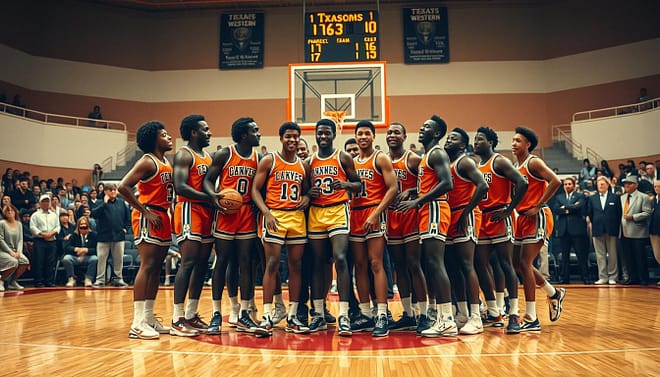
The starting five Black players made a powerful statement in 1966. It was more than a coaching choice. Coach Don Haskins chose the best players, regardless of color. The 72-65 win showed that the best team wins, not just the whitest.
This moment, known as the “Miners’ Miracle,” shook Texas. It showed that integrated teams could win big. High school coaches across Texas quickly changed their ways. They saw that talented Black athletes could get college scholarships.
The effects were huge, both in practice and in minds. Southern college coaches, who respected Rupp, saw their model fail. The fear of losing to integrated teams grew. Texas basketball integration history changed forever. It showed the whole region that integrated teams could win.
The table below shows how attitudes and strategies changed after the game:
| Aspect | Pre-1966 Norm (Southern Colleges) | Post-1966 Trend (Accelerated Change) |
|---|---|---|
| Starting Lineup Composition | Predominantly or exclusively white players. Token integration was rare. | Active pursuit of Black talent to build competitive starting fives. Merit over tradition. |
| Primary Recruiting Geography | Focused on local, segregated high school networks and traditional pipelines. | Expanded searches into urban centers and historically Black high schools across Texas and the South. |
| Stated Coaching Philosophy | “System” and “fundamentals” were often coded priorities. | “Athleticism” and “talent” became public mantras, acknowledging a new style of play. |
| Public & Media Perception | Integration was a social issue, often framed as a risk or controversy. | Integration became a winning strategy. Success helped sell the change to skeptical audiences. |
| Competitive Results | Southern teams often faltered against faster, more athletic integrated teams from other regions. | Southern programs that integrated began reaching deeper into the NCAA tournament, changing national power dynamics. |
In Texas, the impact was huge. Schools like the University of Houston, which had already integrated, felt vindicated. Schools that hadn’t integrated felt the pressure. How could they explain not trying to follow Texas Western’s lead?
The game showed the power of integration in sports. It was a clear win for the civil rights sports Texas movement. The score was more convincing than any court ruling for many. It showed that basketball’s future was integrated, and Texas had its first champion.
High school consolidation, travel, and game-day changes
The PVIL to UIL merger was more than just paperwork. It changed schools, budgets, and game-day traditions. It was a big change that no one expected.
Many proud Black high schools closed or merged. This meant losing community centers. The Pride and Prowess of the PVIL were lost in the change.
Travel times increased a lot. Games were now far away, needing early starts and extra food. Bus drivers became heroes of integration.
Game nights changed too. Thursday games became Friday night lights. This change was big, affecting the community’s spirit.
The merger brought many practical problems. Equipment and schedules had to change. Small towns had to make tough choices about resources. A report on school segregation and disintegration showed how these changes affected communities.
Players faced a new reality. They practiced in new gyms but traveled past old schools. This made it hard to feel at home.
The PVIL to UIL merger was the hard part of desegregation. It changed game days, rivalries, and travel. It was a big adjustment for everyone.
Media coverage and community reactions across regions
To grasp the full impact of integrated basketball, you had to look beyond the headlines. The battle for civil rights was as intense in the press as it was on the court. Your choice of newspaper often showed your political leanings.
The The Daily Texan stood out as a voice of progress. It wasn’t just reporting news; it was advocating for change. Editorials pushed for integration, highlighting the achievements of Black athletes in a groundbreaking way.
On the other hand, the mainstream Texas press often remained silent or subtly opposed. They might not mention Black players in game reports. Even when they did, the focus was on the white team, downplaying the achievements of Black athletes.
The Black press, like the Houston Forward Times, told a different story. They celebrated Black athletes, making them the stars of the game. Their coverage was vibrant and proud, creating a world where Black excellence was celebrated.
| Aspect | Mainstream (White) Press | Black Press (e.g., Forward Times) |
|---|---|---|
| Primary Role | Event recorder; often status-quo guardian | Community advocate and myth-maker |
| Coverage Focus | White teams/players; integration as disruption | PVIL athletes; achievement as empowerment |
| Narrative Tone | Detached, sometimes hostile or silent | Celebratory, detailed, and deeply invested |
| Impact on Civil Rights | Often slowed progress by ignoring it | Accelerated pride and documented the movement |
In cities like Austin, student crowds were often supportive of integration. Their enthusiasm was about being on the right side of history, not just cheering for a team.
In rural areas, the mood was different. Fans might not even read the box scores. The idea of civil rights in sports was seen as an unwanted change. Reactions ranged from indifference to outright hostility, showing that integration was not always accepted.
The Black press was clear in their support for integration. They were the ones leading the narrative. The mainstream press was slow to catch up, but the talent on the court eventually made their silence impossible to ignore. The community’s reactions were complex, reflecting the hopes, defiance, resistance, and gradual change happening across Texas. You could hear all these voices, if you knew which paper to read.
Recruiting shifts and college opportunities for Black athletes
Michael Hurd’s words hit home: “A lot of the top black athletes back then went to Prairie View like now a lot of the guys go to UT.” This sentence shows how the desegregation timeline changed college sports. It was a big change in direction.
For years, top Black athletes from Texas high schools went to HBCUs. Schools like Prairie View A&M and Grambling were more than just colleges. They were cultural centers and sports training grounds.
Then, the Southwest Conference (SWC) opened its doors. This changed everything. Was getting a scholarship to a white school better? Or was it a trade-off?
The change was huge. HBCUs lost their top talent. The profound disruption to their tradition was immediate. SWC schools, now needing to integrate, looked elsewhere for talent.
More visibility and resources were the big draws. Playing in the SWC meant national TV, better facilities, and more pressure. It was a chance to play on a bigger stage. But what did they lose?
The HBCU system was more than sports. It was a community. Coaches were like mentors, knowing the athletes’ backgrounds well. Games were community events, filled with shared identity. Moving to a white school meant leaving that support behind.
Was this more choice a win? The answer is complex. Athletes had more options. But HBCUs faced a big challenge. The desegregation timeline gave Black athletes new choices. But it also changed the HBCU system.
This change created a new era. Texas talent could aim for schools like Arkansas, Houston, or UCLA. The pipeline split into many paths. This led to progress and loss. The game integrated, but at a cost.
Lasting cultural legacies and unresolved tensions
The move from ‘desegregated’ to ‘integrated’ was slow and ongoing. It left a legacy of both brilliance and bitter tension. We integrated the teams and retired jerseys. But now, we question if we truly won or just changed the rules.
In Austin, T.J. Ford’s number 11 and Kevin Durant’s 35 hang in the rafters. These are our modern relics, the convenient nostalgia of progress. We celebrate these Black stars, but forget the PVIL gyms that were closed for them. The ceremonies are moving, but the legacy feels incomplete.
The cultural impact goes beyond the court. Aaronetta Pierce in San Antonio wasn’t a player but an early investor in the Spurs. Her story shows the broader victory—from the sidelines to the boardroom. Yet, how many like her were lost in the transition?
This brings us to the key difference in our Texas basketball integration history. ‘Desegregated’ means doors were opened. ‘Integrated’ means everyone has a real seat at the table. We achieved the first with court orders and brave seasons. The second is an ongoing challenge.
The unresolved tensions are like ghosts in this gym. The closed PVIL schools and faded traditions of communities that lost their hubs are forgotten. For every jersey retired, a piece of history was quietly boxed up. The final score isn’t clear; it’s a complicated tie with asterisks and footnotes.
| The Scoreboard: Desegregated vs. Integrated Realities | What It Looks Like Today |
|---|---|
| Desegregated | Black and white players on the same roster |
| Integrated | Equitable access to coaching, resources, and legacy recognition |
| Desegregated Legacy | Retired jerseys of Black stars in major arenas |
| Integrated Legacy | PVIL history taught alongside UIL history in Texas schools |
| Desegregated Culture | Celebrating individual pioneers like Aaronetta Pierce |
| Integrated Culture | Systemic investment in Black-owned sports businesses statewide |
The game continues, with modern rivalries and recruiting battles. Like the intense Texas vs Iowa State basketball saga. They’re played on this integrated court, but on a fractured foundation.
We’re left with monuments and silence. The retired numbers whisper of talent recognized. The empty lots where PVIL schools once stood scream of communities disrupted. The Texas basketball integration history isn’t a chapter we closed. It’s a game we’re all playing. The real question isn’t “Did we win?” It’s “Are we playing fair yet?”
Archival guide: newspapers, PVIL yearbooks, school archives
Think the story ends here? The real game is in the archives. Your next play is to visit the primary sources.
For the full desegregation timeline, start with the Texas Black History Preservation Project. Black newspapers like the Houston Forward Times reported the games the mainstream press ignored. Their pages hold the unfiltered pulse of the community.
Where are those crumbling PVIL yearbooks? Check university special collections. These artifacts are gold for understanding the cultural shift during the PVIL to UIL merger. Faded team photos and handwritten stats tell a story no textbook can.
Want the student perspective? Dive into The Daily Texan archives on microfilm. Read the defiant editorials written as integration unfolded. Local historical societies often hold the scrapbooks and oral histories from coaches and fans.
The best research feels like detective work. You’re piecing together a narrative from grainy photos and faded ink. Go find the evidence yourself. The archives are waiting.