Forget the polished hardwood of the AT&T Center. The real story of hoops in this state starts with the sound of a ball bouncing on cracked concrete. It’s the soundtrack of my youth, chasing a loose Spalding through a chain-link fence as the Texas sun beat down.
This isn’t just nostalgia. It’s cultural cartography. How did post-war urban planning and sheer Texan grit create distinct basketball ecosystems from Houston to Dallas?
The asphalt courts along the I-35 corridor bred a different style than the Gulf Coast’s outdoor rims. These spaces became the state’s unofficial, and most vital, basketball incubators.
Let’s map the socio-geographic evolution of these iconic spaces. We’ll analyze how demographic shifts turned neighborhood lots into proving grounds. The history of Texas playground hoops is written in warped baselines and faded paint.
Fonde Rec Center and other legendary runs
Houston’s Fonde Recreation Center is more than a gym. It’s a place where legends are born and legends are broken. It’s like the Louvre of Texas pickup basketball. To understand Texas’s pickup culture, you must visit this building. Here, the air is filled with sweat and the smell of legacy.
Fonde became famous for a reason. Its location near downtown Houston attracted everyone from NBA stars to college kids. The competition was fierce. I’ve heard stories of All-Pros getting outplayed by a local postal worker. Here, your reputation was earned every game.
But Texas has more than Fonde. Austin’s Gregory Gym and Dallas’s “The Cage” are also legendary. Each place has its own story and vibe. Was it the lighting, the rims, or the ego?
What makes a place like the Fonde Recreation Center? It needs to be accessible and have a lot of talent. And it needs stories to make it legendary. The tales of midnight games and trash-talkers are part of the game’s history.
The code was key. You didn’t call weak fouls. You defended hard and passed to the open man. These rules were learned by playing. Break them, and you might not be invited back.
Comparing these places is like comparing sacred texts. Fonde Recreation Center was the center, but Gregory Gym and “The Cage” had their own stories. Each place added to the tapestry of Texas basketball. They were where style was invented and egos were broken.
So, what did these legendary runs teach us? They were more than games. They were social hubs, cultural markers, and proving grounds. The Fonde Recreation Center and its peers show us that important history is often made in unexpected places.
Church-league rivalries and Saturday-night gym culture
Forget the Alamodome; the real pressure cooker in Texas basketball was often a fluorescent-lit gym attached to a Baptist church. While the pros played for millions, we played for pride, potluck supremacy, and bragging rights. This wasn’t just recreation; it was a social registry written in jump shots and defensive slides — a place where players learned toughness the hard way, long before modern conversations around athletic injury and scar recovery became part of athlete care.
The YMCA leagues Texas offered a more ecumenical melting pot. Here, Methodists might find themselves boxing out Presbyterians, while agnostics just wanted a good run. The culture was slightly more bureaucratic — think official scorekeepers and printed schedules — but the underlying currents were the same. These games were where you learned who could handle pressure and who would crack under the gentle heckling of a deacon.
So, was the Baptist league more physical than the Methodist? Absolutely. It was a theological extension of defense-as-doctrine. The Methodist games tended toward a more motion-oriented, egalitarian offense. The real church-league rivalries, though, were intra-denominational. Two First Baptist teams from different parts of town could generate more heat than a summer revival.
Geography played its part, too. A YMCA leagues Texas game in Fort Worth often had a deliberate, set-play feel, reflecting the city’s stockyard logistics. Out in El Paso, the pace was faster, the play more freelance, mirroring the border’s cross-cultural energy. The style wasn’t just about players; it was about place.
Saturday night was the holy hour. The air smelled of polished hardwood, stale popcorn, and anticipation. Families filled the bleachers, kids ran in the halls, and crockpots lined folding tables in the fellowship hall. The squeak of sneakers was our choir music. These church-league rivalries provided a safe, structured outlet for competitive fire, all wrapped in a post-game handshake line and a prayer.
For the YMCA leagues Texas, the vibe was similar but secularized. The community center became a town square for young professionals and retirees alike. The competition was just as fierce, but the post-game debrief might happen at a local diner instead of a church basement. The function, though, was identical: community cohesion through controlled conflict.
This ecosystem produced a uniquely Texan brand of team play. It was unselfish but tough, strategic but adaptable. You learned to read people, not just plays. The guy who fed you the ball on Saturday might be your loan officer on Monday. These decades-long church-league rivalries forged bonds and petty feuds that shaped small-town social dynamics more than any city council meeting.
In the end, the legacy of the YMCA leagues Texas and church circuits isn’t found in trophy cases. It’s in the lingering sense of belonging, the shared memory of a last-second shot that missed or made, and the understanding that sometimes the most meaningful battles happen far from the bright lights.
Women’s and co‑ed leagues as community hubs
Think Texas hoops culture is all about male bravado? Think again. Co-ed league games show a different side of Texas basketball. Women’s church teams and co-ed leagues were the real heart of the community, long before we called it “social capital.”
Women’s teams from churches like St. Luke’s or First Methodist were huge. Their games were Saturday night events, full of competition and friendship. It was more than basketball; it was a chance to catch up with neighbors and plan community events.
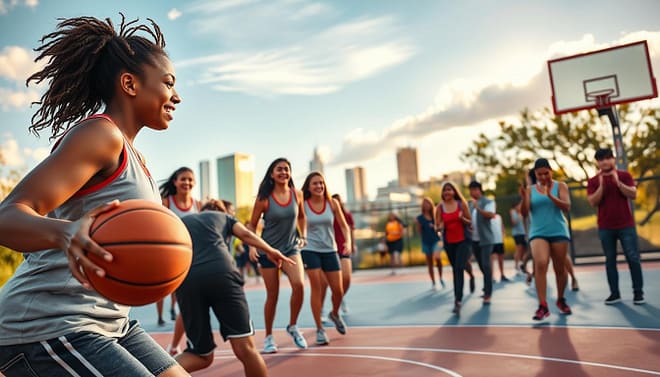
Co-ed leagues changed the game. They showed that size and speed weren’t everything. The game became a strategic battle of positioning and passing. The smartest players won, not just the strongest.
So, why were these places so important? They offered a neutral space where everyone was equal. Your teammate could be anyone, from your boss to your kid’s teacher. This made the court a place of leadership and teamwork.
The impact of these leagues is huge. They taught the value of smart play over ego. They also built strong social networks that helped the whole community. To miss this part of Texas basketball history is to miss the game itself.
Style, slang, and unwritten rules of pickup play
When you step onto a Texas blacktop, it’s more than just basketball. It’s entering a world with its own rules and slang. The official rules are just a guide. The real rules are passed down through generations of players.
This pickup culture has its own language. A made basket is called a “bucket.” A bad shot gets dismissed with “Get that weak stuff outta here!” The key word? “Next.” It means your team gets to challenge the winners, starting a cycle of competition.
In Houston, you’ll find the “slasher.” This player zooms through the paint like it’s a highway. Their moves are a result of the city’s hot summers, where space is limited and creativity is key.
Head to San Antonio, and you’ll meet the “fundamentalist.” This style focuses on precision. It’s all about making smart passes and shots, like a chess game.
These styles aren’t just stories. They guide you through the local pickup culture.
| Region | Style Archetype | Key Traits | Signature Move |
|---|---|---|---|
| Houston | The Slasher | Explosive drives, creative finishes, streetball flair | Euro-step through traffic |
| San Antonio | The Fundamentalist | Precise passing, off-ball movement, high-percentage shots | Corner bank shot |
| Dallas | The Showman | Highlight-oriented, confident handles, deep range | Step-back three-pointer |
Style and slang are just the surface. The real heart is the unwritten rules. These rules keep the game fair. First rule: call your own fouls. It’s all about honesty.
Second rule: take the ball back after a score. This rule keeps the game balanced. It gives defense a chance to set up.
The third rule is about behavior: don’t be a “ball hog.” Over-dribbling will get you left out. The court balances itself.
These unwritten rules create a fair system. They reward honesty and teamwork. You learn by doing, not just by following rules.
This system is beautiful and chaotic. It turns strangers into a team for 15 points. The rules are agreed upon, not imposed. That’s the magic of the blacktop.
Local legends who never went pro but shaped the scene
Beyond the bright lights of the AT&T Center, a different group of heroes exists. They are the local legends who shaped Texas playground hoops. Their achievements aren’t listed on Basketball Reference. Instead, their legacy is found in the faded lines of a blacktop and the memories of a neighborhood.
First, there are the mythical scorers. Every city has one. Guys like “Sweetwater” or “L-Train” were known for their incredible crossovers. They’d show up, score 40 points, and then disappear.
Then, there are the institution players. These are the guys who dominated the same spot for years. They weren’t just playing; they were stewards. They knew every rule and every regular, and they took winning very seriously.
You can’t talk about these legends without mentioning the defensive stalwarts. These were the glue guys who shut down the scorers. They were known for their positioning, communication, and refusal to lose. Every great team had one.
So, what’s their real legacy? It’s not in trophies. It’s in style and mentorship. They passed down the game’s history and taught the next generation. They raised the level of play by demanding it.
These figures are the true heart of Texas basketball culture. They are the sages. While pros come and go, these local legends provide continuity. They turn a simple game of Texas playground hoops into a tradition. And that’s the most valuable assist of all.
How pickup influenced scholastic and college styles
The mix of pickup culture and scholastic styles in Texas was not smooth. It was a battle where creativity clashed with basics. For years, high school coaches watched the court with a mix of wonder and doubt.
They saw incredible talent and skills. But they also saw “bad habits.” For example, taking a three-pointer with just 20 seconds left was seen as a mistake.
Despite this, coaches did recruit from the playgrounds. But they tried to change these players. They wanted to replace their natural skills with set plays. This was a battle between needing talent and fearing its unpredictability.
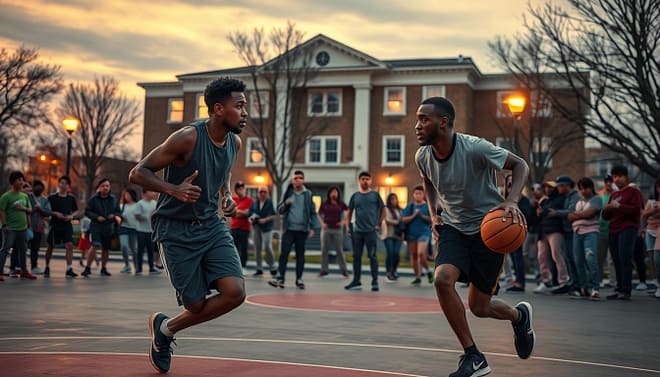
The pickup culture was too strong to ignore. It influenced basketball, even if it was not always acknowledged. The one-on-one skills and defensive toughness became key parts of the game.
Some teams embraced this mix of styles. They used the playground flair in their games. Coaches ran certain plays but gave their best players freedom to make plays.
The debate over fundamentals versus flashiness continued. Some said the playground taught selfishness. Others saw it as a place to learn to solve problems under pressure. It’s hard to say what’s a “bad shot” when a player has spent their life making tough shots.
This mix changed Texas college basketball. Recruiters looked for more than just athletes. They wanted players who could make plays when needed. This was a true pickup culture skill.
In the end, both the structured systems and the playground found a balance. Modern scholastic styles in Texas show this blend. You’ll see complex plays designed to create one-on-one situations. Defenses focus on pressuring the ball, just like on the playground.
This mix of X’s and O’s and playground skills created something special. Texas basketball was shaped by this unique blend.
Safety, access, and gentrification pressures on courts
Ask any local legend about their favorite court, and you might get a story. Then, a sigh and directions to a condo complex or a locked park gate. The romanticized history of playground ball hits the hard asphalt of modern reality. The cultural landmarks we’ve mythologized are literally being paved over.
Municipal budgets are tight. Parks and recreation departments often face the cruelest cuts. Maintaining a court—resurfacing asphalt, replacing nets, fixing rims—isn’t a revenue generator. So, what’s the first thing to go? The evening lights. Officially, it’s to “discourage loitering” or save on electricity. Unofficially, it’s a death sentence for the after-work run. This isn’t just about inconvenience; it’s a direct attack on court access for anyone who isn’t a student or has a day job.
Safety concerns, both real and perceived, compound the problem. Isolated courts can attract more than just ballers. The easier municipal fix is removal. The hoops come down. The space becomes a “passive green area.” The community loses its casual gym, its neutral territory, its pressure valve.
Then comes the bulldozer of gentrification. That iconic, chainless court in a historically Black or Latino neighborhood? It sits on suddenly valuable land. The narrative flips. The vibrant, noisy community hub is re-framed as an “underutilized asset” or a source of “undesirable activity.” The blueprint arrives. Mixed-use development. Luxury apartments. A dog park. The concrete where generations learned crossovers is now a foundation for a yoga studio charging $30 a class.
What is lost is intangible but profound. It’s the loss of a free, democratic space. You don’t need a membership, a reservation, or the right zip code. You just need a ball and some nerve. This erosion of public space is a quiet crisis. When a court vanishes, where does that community energy go? Where do the teenagers settle their beefs? Where do the dads get their weekend exercise?
The pressure of gentrification isn’t just physical displacement. It’s cultural erasure. It tells a community that its history, its rhythms, its unofficial institutions are less valuable than property taxes and curb appeal. The fight for these courts is, at its core, a fight over who gets to define the soul of a city.
So, the next time you drive by an empty lot or a shiny new complex, ask the tough question. Was there a baseline here? Were there legends made? The answer is often yes. And that silence is the real scoreboard.
Photographing and preserving playground history
What happens to a culture when its main places are parking lots and memories fade? Texas playground basketball’s spirit is fleeting. It lives through jump shots and dribbles, not in books.
Photographers have been capturing this spirit for decades, mainly at Fonde Recreation Center. Their work is more than sports photos. It’s a way to preserve culture. They freeze moments of joy and struggle, creating a lasting record.
But photos can’t tell you about legendary moves. That’s where oral historians come in. They seek out legends, recording their stories and slang before it’s lost.
This effort often turns into activism. When courts face demolition, archivists fight to save them. It’s not just about the floors. It’s about preserving a community’s heart.
Documenting these spaces is a big task. It involves local archives and municipal records. These documents are dry but essential, providing the framework for the living history.
So, why is this important? It’s not just about sports nostalgia. Preserving this history protects Texas’s social and cultural heritage. The playground was a microcosm of community and style. Losing this story erases a part of Texas’s identity.
A visitor’s guide to archives and community storytellers
So you’ve read the tales. Where do you go to touch the real thing? This guide will help you move from just reading to actually exploring.
Start by visiting physical archives. The Texas Archive of the Moving Image might have old game footage. Local historical societies in Houston, Dallas, or San Antonio have photos from forgotten YMCA leagues Texas. These records are like the stats of a bygone era.
The real treasures are the people. Look for the old-timers at community center games. Buy a coffee for a retired league organizer. Their stories are priceless, unlike anything in a book.
Want to see the culture in action? Go to a modern church league final or a Saturday run at a city park. The vibes are similar, even if the slang has changed.
This history isn’t locked away. It’s on a cracked blacktop, in a church basement, in the memories of players who never left. Your next step isn’t to close this tab. It’s to find a court and ask a question.