
The history of high school hoops is filled with numbers. But what about the stats that are missing?
There’s a world of legendary performance milestones beyond official records. These are the “known unknowns.” They’re incredible feats that are part of local lore but lack proof.
Imagine Greg Procell’s estimated 3,173-point season or Demond “Tweety” Carter’s amazing plays. Players like Jackie Moreland and Harold Ray Strother were known for their incredible numbers. These were often talked about more than they were officially recorded.
The Lone Star State’s love for prep sports creates a perfect setting for these stories. Before digital records, keeping track of everything was hard. Stories were shared, not always written down.
This article dives into that interesting gap. We’ll look at the numbers, the stories behind them, and their lasting impact. Get ready for a journey where myth and stats meet.
Individual Scoring Performances
The history of sports is filled with scoring records that seem like they belong in a storybook. These numbers show more than just points. They show willpower, skill, and sometimes being in the right place at the right time.
These legendary feats fall into three categories:
- Single-Game Explosion: The ultimate one-night stand of offensive production.
- Season-Long Dominance: Sustained excellence over a full schedule of games.
- Career Achievement: A legacy built on consistency and longevity.
Danny Heater holds the record for the most points scored in a single game. He played for Burnsville High School in West Virginia in 1960. Heater scored an unimaginable 135 points. He took 70 field goal attempts, making 53, and hit 29 free throws out of 41.
In Louisiana, Greg Procell holds the national season record with 3,173 points. Demond “Tweety” Carter has the career record with 7,494 points. These records show a different kind of greatness. It’s not just one night. It’s about dominating game after game for months or years.
Texas also has a proud place in this conversation. Kenneth Johnson of nearby Grandfield, Oklahoma, once scored 105 points in a game. But a Texan holds a record of remarkable precision. Tristen Newton of Burges High School in El Paso set the national record for free throws made in a season in 2018-19. He made 425 free throws. This record shows the value of relentless consistency and clutch performance from the free throw line.
What does it take to set these scoring records? Single-game records often need a relentless volume of shots and a team willing to feed the hot hand. Season and career records demand durability, skill, and the ability to perform at a high level every night. Whether it’s a one-time explosion or years of excellence, these performances define the limits of high school basketball.
Team Achievement Records
To understand a team’s history, look beyond wins and losses. Basketball statistics show true dominance. Individual stars win games, but team excellence builds legends.
Key team basketball statistics give a full picture. The final record is key, but not everything. Analysts also look at average point differential, showing a team’s talent and system.
Strength of schedule matters too. Beating weak teams is less impressive than beating top-ranked ones. Defensive metrics, like points allowed per game, show a team’s discipline and toughness.
National history sets clear benchmarks. The 1981-82 Dunbar Poets went 29-0 with future NBA stars and a legendary coach. Their point differential was impressive. The 1992-93 Oak Hill Academy squad also went undefeated, showing elite talent and coaching.
How do Texas teams stack up? Texas has dynasties with impressive basketball statistics. A Texas team aiming for history needs top talent and a great coach. They must also face elite opponents.
The table below compares legendary national teams with Texas dynasties. It shows the complex nature of team achievement records.
| Team (Season) | Record (W-L) | Avg. Point Differential | Notable Star | Head Coach |
|---|---|---|---|---|
| 1981-82 Dunbar Poets | 29-0 | +32.1 | Reggie Williams | Bob Wade |
| 1992-93 Oak Hill Academy | 36-0 | +28.7 | Jerry Stackhouse | Steve Smith |
| 2021-22 South Oak Cliff (TX) | 33-5 | +19.4 | Kyron Henderson | James Mays II |
| 2022-23 Duncanville (TX) | 35-1 | +24.8 | Ronald Holland | David Peavy |
These basketball statistics tell more than just numbers. A high point differential shows a team’s strength. A future star indicates top talent. The coach’s name shows a team’s culture and system.
For a Texas team to be national contenders, they must check all boxes. A perfect or near-perfect record is key. Dominant wins against strong opponents show greatness. Team achievement records are a complex mix of data, story, and the pursuit of greatness.
Overtime Marathons and Epic Games
Games that push athletes to their limits create lasting legends. These contests are more than just scores. They are stories told for generations.
These games are the peak of competition. They show endurance, will, and clutch play are key to greatness.
The Crucible of Atmosphere
An epic game needs a special atmosphere. A packed gym with cheering fans creates electric pressure.
Playoff games or long-standing rivalries raise the stakes. Every play feels huge. The energy pushes players to do the impossible.
When Time Stands Stil: The Overtime Marathon
Multi-overtime games test a team’s strength. What starts as a four-quarter game turns into a long battle. Players use all their stamina and focus.
Each overtime is a new test of strength. For high school athletes, these games are career-defining moments. They show their ability to endure.
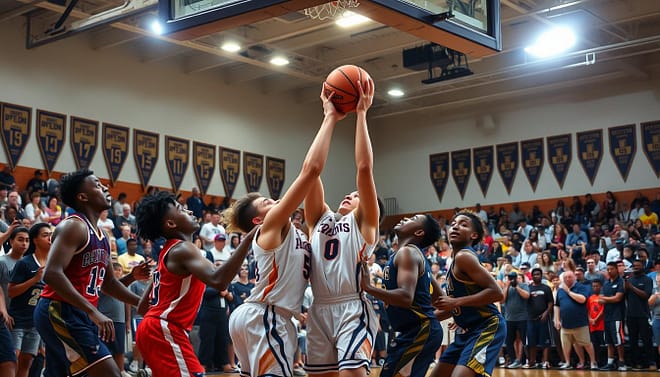
Epic games often feature legendary matchups. Future stars face off, trading baskets in a personal battle. These duels captivate everyone.
Games with massive comebacks are unforgettable. A team coming back from a big deficit shows incredible heart. The swing in momentum is palpable, turning defeat into victory.
Beyond the Box Score
Even historic individual performances, like a 100-point game, gain meaning from the game’s context. Such a feat shows incredible team flow and pace, as well as one player’s skill.
It takes all high school athletes to keep the game intense. Sadly, many epic contests from the past are lost to history. They are remembered only in local lore.
Their legacy lives on in the communities that saw them. These stories remind us that the best tales are often told on the court, not just in records.
Records That Stand Today
High school basketball records have stood the test of time. These scoring records are not just numbers. They are legendary achievements that have lasted for decades.
Danny Heater’s 135-point game in 1960 is a legendary feat. Greg Procell’s 3,173 points in 1970 is another. Demond Carter’s 7,494 points in 2006 is a remarkable achievement.
Texas has a record that stands out nationally. Tristen Newton’s 425 free throws in 2019 is a state record. It’s also a national benchmark for free throw consistency.
Why have these scoring records endured? It’s because of a combination of factors that don’t exist today.
- Game Pace: The fast-paced games of the past led to more shots.
- Defensive Strategies: Today’s team defenses make it harder for one player to dominate.
- The Rarity of the Feat: Each record needed talent, the right circumstances, and a coach’s philosophy.
There are “known unknowns” in record-keeping. Some records might have been broken but never verified or documented. This adds to the mystery of the records we know.
Texas is a key player in this story. Its deep talent pool and competitive spirit make it a threat to records. When a Texas record falls, it gets national attention.
Which records are truly unbreakable? Heater’s 135-point game is likely forever. Procell’s and Carter’s totals are vulnerable but need a once-in-a-generation talent.
Newton’s free throw record is different. It’s a skill-based achievement that could be matched. It requires a player who draws fouls and has nerves of steel.
Looking at these scoring records shows basketball’s evolution. The shift from individual to team play is clear in these numbers. They are the ultimate challenges for every new generation of players.
The Athletes Behind the Numbers
The record books are filled with numbers, but it’s the high school athletes who brought them to life. Their performances were extraordinary. Each record tells a story of dedication, talent, and sometimes, luck.
Take Bruce Williams, known for his rebounding. His record wasn’t just about height. It was about his anticipation, positioning, and endless energy. Julian Newman’s records for assists and three-pointers show his genius. He had vision, practiced a lot, and understood the game well.
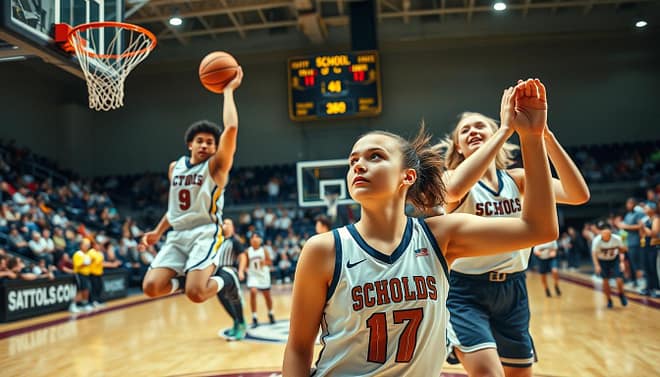
Defensive records have their own stories. Jason Kidd’s steal record came from hard work, quick hands, and understanding the game. William Lee’s record for shot-blocking was about timing, athleticism, and fearlessness. These athletes laid the groundwork for their future success.
Legendary teams also have compelling stories. Players like Muggsy Bogues, Reggie Williams, and Jerry Stackhouse didn’t just score points. They were shaped by intense competition against other Texas teams. Their prep careers prepared them for college and the pros.
Some legends are known mainly at the high school level. Danny Heater’s 135-point game was a perfect storm. It was a night where everything went right. Female pioneers like Cheryl Miller and Lisa Leslie also made history. They showed the world what women’s basketball could be.
The path after setting a record varies. Some go straight to college stardom and the pros. Others reach the peak of their careers at high school. What they all share is the moment they became legends.
| Athlete | Record Category | High School (State) | Post-High School Path |
|---|---|---|---|
| Jason Kidd | Steals (Game & Season) | St. Joseph Notre Dame (CA) | NBA All-Star, Hall of Famer |
| Cheryl Miller | Scoring (Game – 105 pts) | Riverside Poly (CA) | College Star, Olympic Gold, Coach |
| Julian Newman | Assists, Three-Pointers | Downey Christian (FL) | College Basketball Career |
| Bruce Williams | Rebounds | Various Texas Schools | Continued basketball at collegiate level |
| Danny Heater | Points (Single Game – 135) | Burnsville High (WV) | Local legend; did not play professionally |
To join this club, talent is just the start. The real effort is in early morning workouts, tough conditioning, and studying opponents. These athletes aimed to win, improve, or just love the game. Their dedication was unmatched.
Their impact goes beyond records. They set a high standard. They inspire future athletes to push their limits. Their stories remind us that it’s the human spirit that makes records unforgettable.
How Records Impact College Recruiting
College recruiting relies heavily on data. High school basketball statistics show a player’s true talent. For coaches, a standout record is more than just a headline. It’s proof of a player’s worth.
What do coaches look for in stats? A big game score is eye-catching, but steady performance wins trust. Points, rebounds, and assists over a season show a player’s reliability. All-around contributions are key, like steals and blocks for defense, and assists for teamwork.
Coaches check stats to answer big questions:
- Can this player score well against top teams?
- Do they help the team in more ways than scoring?
- Is their success due to the team or their own skills?
A record-breaking game can change a player’s career. It can turn a local star into a national recruit fast. Scouts and college coaches take notice. This leads to invites to top showcases and games.
For years, the path to college has followed this pattern. Players like Reggie Williams and Jerry Stackhouse used their high school stats to get scholarships. Their records were not just for history. They were the first thing colleges saw.
In the end, basketball statistics are a common language. They turn raw talent into scholarship offers. A record proves a player is worth noticing by top teams.
Technology’s Role in Modern Record Keeping
Tracking Texas high school basketball records used to rely on local newspapers and coaches. Now, digital platforms have changed everything.
Services like MaxPreps and Hudl offer real-time leaderboards. They let us check stats right away. This makes our records more accurate.
Technology lets us track more than just points and rebounds. We can now see assists, steals, and shooting efficiency. These platforms show how athletes perform across the country.
But, there are challenges. Making sure all schools can use technology to report is key. A record is only official if it’s logged and checked.
At the heart of these records are the athletes. Their hard work and dedication are what make the data meaningful. Technology helps us keep track, but the athletes create the stories.