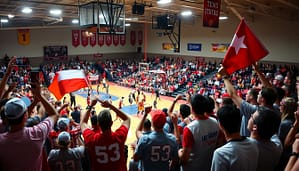
Imagine Springfield, Massachusetts, in 1891. A harsh winter had Dr. James Naismith looking for something to do inside. He nailed peach baskets to a gym balcony and used a soccer ball. He made thirteen simple rules, focusing on skill and sportsmanship.
Now, imagine Texas at that time. People were likely wondering about this “basketball” thing. It was a Yankee sport, and the cultural gap was huge.
This story is more than sports history. It’s about how a game with peach baskets became a Texas tradition. We’re exploring how the game first reached local schools. It’s like the pre-game show for a huge fan base. The game went from a curiosity to a beloved part of Texas culture, thanks to forgotten courts.
Basketball Arrives in Texas Schools
The story of basketball’s arrival in Texas is not about a sudden invasion. It’s a tale of slow, persistent cultural seepage through the YMCA’s institutional pores. While Friday night lights defined the state’s identity, a different game was quietly taking root in gymnasiums.
So, who were the patient gardeners in this Texas sports history? Look to the Young Men’s Christian Association. In the late 19th and early 20th centuries, the YMCA was the original viral network. Its graduates, from physical education powerhouses like Springfield College, were the early influencers.
These men didn’t have social media. They had a mission—”muscular Christianity”—and a new game to promote. They spread across the country, taking coaching and P.E. jobs. Many ended up in Texas.
Their toolkit was simple: a ball, a couple of peach baskets (or their equivalent), and a rulebook. Their battlefield? Any available hall, armory, or school gym they could commandeer. The first dribbles in Texas weren’t heard in major arenas. They echoed in these modest, often dusty spaces.
The logistical hurdles were immense. Texas wasn’t built for indoor sport. Football required a field. Baseball required a diamond. Basketball required a floor—a smooth, enclosed surface. This was a rare commodity. Early games were often played in rooms never designed for running and jumping.
Then came the cultural hurdle. Was this just a divertissement for the cold months? A harmless way to keep boys active when football season ended? Many school administrators saw it that way. A wintertime filler. Nothing more.
But the game itself had other ideas. The early evangelists—those P.E. instructors—saw a spark. They saw the immediate appeal of a fast-paced, skill-based contest. It didn’t require twenty-two players or acres of land. It required ten and a single room.
Let’s break down the initial reception:
- The Athletic Argument: It promoted agility and hand-eye coordination in a way football didn’t.
- The Practical Appeal: It was relatively cheap and could be played in existing school buildings.
- The Social Dynamic: It was a team sport that fostered quick decision-making and cooperation.
The competitive fires didn’t take long to ignite. Humans, including Texans, have a hard time keeping score without wanting to win. What began as intramural activity in a P.E. class soon sparked challenges between classes. Then between grades.
The very nature of the game—continuous scoring, constant action—lent itself to rivalry. It was more than a winter pastime. It was a new arena for proving oneself. This was the critical, unexpected turn in Texas sports history.
Picture those first games. The baskets are literal baskets, nailed to a balcony railing. The ball is a soccer ball. The rules are a fluid, local interpretation of Dr. Naismith’s original thirteen. The sound of sneakers (or more likely, hard-soled shoes) squeaking on polished wood. The shouts. The sheer novelty of it all.
Through the YMCA network, the game found its first Texas footholds not in major cities first, but often in smaller towns where a passionate graduate had landed. These men were the apostles of the bounce pass. They built the foundation for everything that followed in Texas high school basketball.
They faced skepticism. They worked with meager resources. But they planted a seed. That seed, against the towering oak of Texas football culture, would eventually grow into its own mighty tree. The journey from curious diversion to cornerstone of Texas sports history had begun.
Early Rules and Equipment
The first rules of Texas high school basketball were simple. They started with peach baskets and a soccer ball. Forget about three-point lines and shot clocks. The first games were a mix of fun and chaos.
The equipment was basic. The “hoop” was often a peach basket nailed up. The ball was a soccer ball, bouncing unpredictably. This was the spirit of early athletics in Texas.
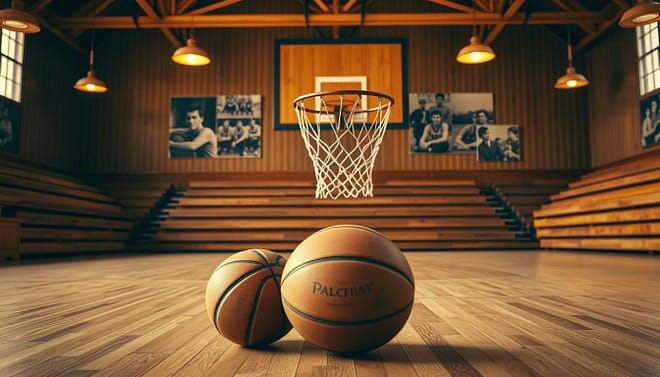
Strategy came from what was possible. Dr. James Naismith’s rules didn’t allow dribbling. Players passed the ball only. It was simple but frustrating.
Scoring was a big deal. Each basket meant someone had to climb a ladder to get the ball. This made every score exciting. The game was slow but full of anticipation.
Naismith’s rules focused on fair play. Players were not allowed to push or hit each other. In Texas gyms, these rules were tested right away. The game’s ethics were shaped in the moment.
This was the start of something new. Texas kids were testing the game. The mix of bad equipment, strict rules, and slow pace made it unique. It was a game of strategy and beauty, waiting to grow.
First Organized High School Games
Early basketball was like jazz, free and full of improvisation. But the first organized games brought structure to the chaos. This change was huge for school sports development. It made winning and losing matter more than just for fun.
The Amateur Athletic Union (AAU) played a big role in this change. They set rules that made basketball a sport you could play anywhere. This made games fair and consistent, no matter where you were.
Who started the first official game between Texas high schools? It’s hard to say for sure. But it was likely around 1914-1915. Imagine a dusty court, a teacher with a rulebook, and a few parents watching. That first whistle was the start of something big.
That first whistle also started rivalry and record-keeping. You need a rival to lose to, and you need to write it down. Early records were on chalkboards, showing wins and losses.
The setup was simple but effective. Letters were used for schedules, and a borrowed truck for travel. These basics helped create the structure of the game.
- Fixed Schedules: Games had set times, creating a “season.”
- Official Scorekeeping: A bookkeeper made scores official, not just memories.
- Designated Venues: Games moved to specific courts, building school pride.
- Uniformed Teams: Matching jerseys made teams look like a single unit.
This was the start of basketball as we know it. It went from a recess game to a big event. It was about more than just playing; it was about representing your school.
The move to organized games was key for any sport. For Texas high school basketball, it was a big step. It made the sport a part of American culture, with dreams and legends to follow.
Geographic Spread Across Texas
Basketball spread across Texas like a virus, adapting to different environments. It didn’t cover the state evenly. Instead, it followed paths of least resistance and greatest opportunity.
The game’s early spread can be mapped by railroad lines and oil derricks. It first reached port cities like Galveston and Houston. Then, it traveled west and north on railroad lines, reaching towns and schoolyards.
Where oil booms happened, basketball followed. Towns like Ranger and Borger, with their young workers, built gyms. Basketball became a social anchor, shaping community identity.
The game evolved in each new place. The rules of basketball history changed to fit local culture. Texas remixed the game, starting with Dr. Naismith’s blueprint.
In West Texas, football was king before basketball arrived. The game became brutally physical, favoring strong play over finesse. It was football indoors.
In cities like Houston, Dallas, and East Texas, the game was different. Smaller courts led to fast, guard-oriented games. Speed and agility were key, contrasting with West Texas’s physical style.
This regional difference is a key part of Texas basketball history. The state’s vast geography and diverse economies created unique basketball styles.
| Texas Region | Primary Influence | Playing Style | Key Characteristic |
|---|---|---|---|
| West Texas / Panhandle | Football Culture, Oil Boom Labor | Physical, Half-Court, Post-Dominant | Emphasis on strength, rebounding, and defensive pressure. |
| Urban Centers (Houston, Dallas) | Limited Space, Diverse Populations | Fast-Paced, Guard-Oriented, Perimeter Play | Priority on speed, ball-handling, and transition offense. |
| East Texas / Piney Woods | Small-Town Athletics, Agricultural Rhythm | Fundamental, Team-Oriented, Strategic | Focus on set plays, discipline, and high-percentage shots. |
The sport’s history in Texas is unique. The state adapted basketball, reflecting local identity. Oil field workers saw their struggles in the game’s physicality. City dwellers saw their hustle in fast breaks.
This spread and fragmentation set the stage for rivalries and strategies. It showed Texas was writing its own chapter in basketball history, one region at a time.
Integration and Equality in Early Basketball
The early basketball scene in Texas was a mirror of society’s exclusions. The story of peach baskets and dreams of championships often hides a harsh truth. Who got to play? The answer shows a stark picture of the era’s inequalities, seen clearly on the court.
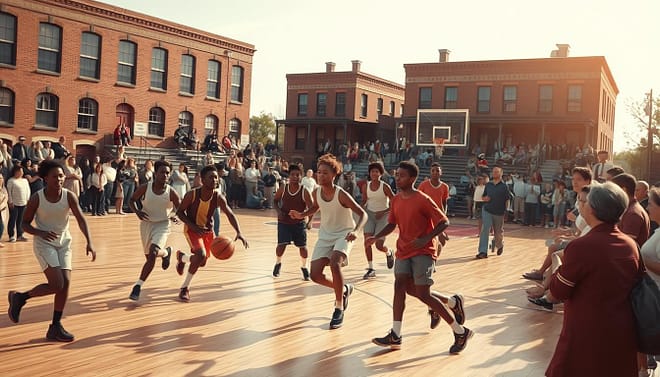
Male players started on a segregated path. While white schools in cities like Houston and Dallas formed leagues, Black communities built their own basketball world. This was not imitation but a separate world of talent and pride. The “separate but equal” rule meant Black athletes played in their own schools, often with worse facilities but just as much passion and skill. The parallel development of the game created two distinct parts of Texas sports history that wouldn’t merge for years.
Women’s story in basketball is equally telling. Enter Senda Berenson Abbott in 1899, who adapted the game for women at Smith College. She changed the rules to make it less strenuous. This version of the game came to Texas, shaping how women played.
In Texas, these rules were both a limit and a chance. They restricted movement but also gave women a “socially acceptable” way to be athletic. Early Texas high school teams faced these rules, mastering the half-court game and developing strategies. Their fight was not just against opponents but against the idea that basketball wasn’t for them. This shows how the game was not just a reflection but an active challenge to norms.
| Demographic Group | Access & Venues | Rule Adaptations | Key Figures/Context |
|---|---|---|---|
| White Male Students | Primary access to new gyms in urban schools; early inter-school leagues. | Standard men’s rules; focus on full-court play and athleticism. | Teams from emerging football powerhouses; first “state champion” claims. |
| Black Male Students | Separate Black schools & community centers; often outdoor courts. | Same standard rules, but with localized stylistic flourishes. | Unofficial city and regional champions within the Black community. |
| White Female Students | Schoolyards and gymnasiums, but play often treated as an “activity.” | Adopted Senda Berenson’s zone rules; limited dribbling, no full-court play. | Female P.E. instructors as early coaches; teams formed through school clubs. |
The early years of Texas basketball did not push for change. Instead, it kept the status quo. The game offered a structured outlet but within strict limits. The real integration—the slow, painful, and courageous breaking down of those limits—was for future generations. This period’s legacy is complex: incredible athletic traditions born in isolation and a reminder of what was lost by keeping them apart. As historical sports commentary often notes, understanding this complex past is key to appreciating the fights that shaped modern Texas sports history.
Evolution of Playing Styles
If you took a modern basketball scout back to a Texas high school gym in 1915, they’d be amazed. The game was slow and had strict rules that seem strange today. But, it was the start of something big.
The game changed a lot because of rule changes. These changes let players show off their skills in new ways. It was a time of freedom in Texas early athletics.
The dribble was a big change. Before, players could only pass the ball. But with the dribble, players could move the ball themselves. This made the game more exciting and unpredictable.
This change led to new strategies. It helped create the fast break and more complex plays in early athletics.
The backboard was another big change. It replaced the peach basket and changed the game. Before, rebounds were chaotic. But the backboard made rebounds more predictable.
It also made the bank shot possible. This added a new way to score. Suddenly, players had to think about positioning and rebounding.
The game became more about size and jumping ability. This pushed early athletics towards the fast-paced game we know today.
The three-point line came later, but it started with these changes. Each rule change made the game different. It made players and coaches think in new ways.
The game changed from a slow, passing game to a fast, dynamic sport. It became more about individual creativity and teamwork. The strategic foundation for modern Texas basketball was built in these early years.
Players back then were part of creating the game we love today. Their early athletics was a key part of basketball’s development.
Legacy of Pioneer Players and Coaches
Where does a pioneer’s legacy truly reside? It’s not just in old trophies, but in the game’s blueprint today. The first coaches and players, who fought for gym time and played without scholarships, laid the groundwork. They built the foundation of modern Texas school sports.
Every packed Friday night gym, every championship banner, and every kid dreaming of a state title honors them. Their legacy is not in points scored but in their determination. They created the stage for future stars, long before anyone knew it existed. Halls of fame are important, as they preserve the essence of a program’s history.
Take Jody Conradt’s statue at UT for example. It stands as a symbol of her 900 wins and the system she built. This system combined academic excellence with athletic achievement, with a 99% graduation rate among her players.
The true development in school sports came from quiet, determined choices. Choices to practice early, to fundraise for uniforms, and to believe in the power of sports. Today’s successful teams are the result of seeds planted by forgotten pioneers. Every dribble in a Texas high school gym is a tribute to their pioneering spirit.