
Imagine 1966. President Johnson signed the Voting Rights Act, but basketball was different. In the ACC, SEC, and Southwest conferences, few Black players were found. It was a secret gentlemen’s agreement that few crossed.
But El Paso was different. This dusty border town was ahead of its time. While the South held back, Texas Western College had integrated in 1955. It was a first for Texas state colleges.
Coach Don Haskins looked north for talent, not just players. He was creating a cultural explosive device. The spark was set before the big game. This tale is about the explosive mix of politics, sports, and race that changed everything.
Building the roster and style of play
Imagine mixing a tough West Texas coach with city basketball stars. That’s what happened with the 1966 Texas Western Miners. They were put together from places where white coaches rarely went.
Moe Iba, the assistant coach, explored the South Bronx and Detroit’s Black neighborhoods. He promised them a chance to play in the desert for a coach few knew. His visits were sometimes risky, showing it was more than just scouting.
The recruits were surprised by El Paso’s desert. Nevil Shed, like others, felt a big culture shock. They traded city life for desert views, finding cacti instead of steers.
Don Haskins, known as “The Bear,” had a strict coaching style. He focused on defense and slow, methodical offense. It was like playing chess, not jazz.
Don Haskins showed his genius by adapting to his players. He didn’t try to change them. Instead, he used their skills to his advantage.
The team’s system was a mix of defense and fast breaks. Haskins’ defense was tough, but his offense let players show their skills. This made the team both strong and fast.
This approach was more than basketball. It was about blending city creativity with Texas toughness. Don Haskins didn’t just coach; he created a unique team culture.
The team’s roster was a mix of talents from different backgrounds. Their style of play was a balance of discipline and flair. Don Haskins showed that these two could work together.
The championship run—key games and moments
History often writes its most memorable moments in unexpected ways. The 1966 title game was one such event. It pitted Adolph Rupp’s Kentucky Wildcats against Don Haskins’s Texas Western Miners. The game was more than just a basketball match; it was a clash of cultures.
Before the game, a bus driver told the Miners they should forfeit. This showed the deep-seated prejudices of the time. But the Miners were determined to prove him wrong.
In the locker room, Haskins gave his team a famous pep talk. He told them only the seven Black players would play. This bold move electrified the team.
David Lattin remembered Haskins saying, “It’s up to you,” and leaving. This was all the all-Black starting five needed to know.
The game started with a bang. David Lattin dunked the ball over Kentucky’s Pat Riley. This dunk was more than just two points; it was a statement of power.
Then, Bobby Joe Hill took over. He stole the ball from Kentucky players and scored easy layups. His 20 points were just the beginning. He was a social critique in sneakers, challenging the old order.
Kentucky’s Pat Riley said the Miners were “more aggressive.” This was more than just hustle. It was a revolution in basketball.
The final score was 72-65. But the real victory was in the Miners’ flawless performance. They proved that an all-Black starting five could dominate.
Texas media and public reaction at the time
Looking back at Texas Western’s win is like seeing history unfold. The biggest sports story of the decade happened, and the media struggled to catch up. The initial reaction was a masterpiece of cognitive dissonance.
The New York Times focused on the score. Sports Illustrated analyzed the game’s tactics. For the white mainstream, the 1966 title was just an upset. The racial lineup was ignored.
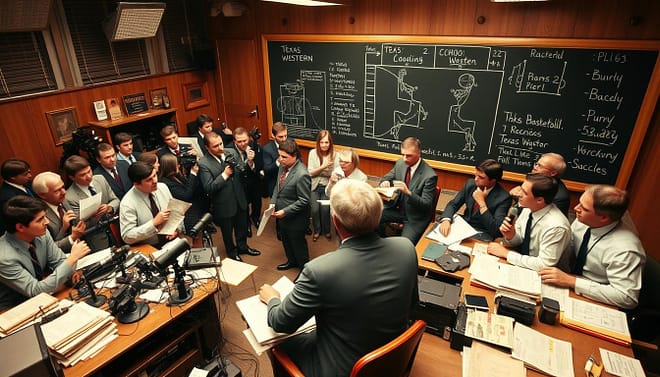
The Black press was aware of the win’s significance but was cautious. Publications like The Chicago Defender celebrated but didn’t make it a civil rights victory. Why was there such restraint?
The moment was too big, too raw. The culture needed time to understand what it saw. The myth of the win was just starting to form. In El Paso, the reaction was pure joy.
Then, a beautiful moment happened. Kentucky’s Louie Dampier visited the Miners’ locker room to congratulate them. This act of sportsmanship was a rare highlight.
In El Paso, Dampier’s gesture was deeply appreciated. He got over a hundred thank-you letters. It was a moment of pure sportsmanship, beyond the win’s historical weight.
The Texas media reaction and national coverage show a key truth. We often look back and understand things differently. But in March 1966, the story was just a sports shocker. The deep social meaning came later.
This delay in recognition is a significant historical lesson. It shows how deeply ingrained some stories are. And how a revolution can be seen as just an upset before it’s fully recognized.
Impact on recruiting and scheduling inside the state
College sports got a new rule after Texas Western won: you need Black talent to win. It wasn’t just a win for morals; it was a winning strategy. Coaches and athletic directors in Texas saw the future and it was different.
The Southwest Conference was all white before 1966. It had only one Black varsity player. People thought Black athletes couldn’t win big games. But Texas Western’s all-Black team proved them wrong in the game that changed college hoops.
Then, things changed fast. The SWC integrated in 1966. The SEC followed in 1967. It wasn’t a slow change of heart. It was a quick move to stay competitive.
Recruiting changed from a social issue to a mercenary pursuit of market efficiency. Southern schools had to win to stay relevant. They needed the best players, and the UTEP Miners showed them how.
Game scheduling also changed. Texas schools couldn’t avoid integrated teams anymore. They had to play teams from the North and West to prove themselves. The whole map of college basketball changed.
Scouts started looking at new places for talent. They looked at playgrounds and high schools they used to ignore. The UTEP Miners didn’t just change the game. They made the whole state’s basketball scene modern and competitive.
Influence on high school integration and coaching attitudes
Integration in Texas high school athletics got a big push from winning. Before 1966, coaches used the excuse that major colleges didn’t integrate. They said, “See? They don’t use them either. It’s a different game up there.”
This excuse was blown away by the Texas Western Miners. They weren’t just athletes; they were technicians. Their win showed the importance of fundamentals, discipline, and staying calm under pressure. This was the real trickle-down effect.
After the game, the focus changed. Keeping high school teams segregated was seen as a bad strategy. It was ignoring a part of the talent pool that had proven itself at the top level:
- Poise: Bobby Joe Hill’s calm steals against Kentucky’s press.
- Disciplined Power: David Lattin’s controlled dominance in the paint.
- Fundamental Soundness: The entire team’s execution of Don Haskins’s system.
Coaches love these qualities. The win gave them a reason to integrate their teams. They could say, “I’m just trying to win like Don Haskins.” This gave them the green light to change their teams.
The old myths about Black players were debunked on the biggest stage. This made it hard for districts to keep teams segregated. The revolution was shown on TV, and every high school gym in Texas took notice. You could join the new era or get left behind.
Myths vs facts from popular retellings
The story of Texas Western vs. Kentucky is often seen as a simple tale of good vs. evil. But the real story is much more complex and interesting. Over time, history has been simplified into easy-to-understand stories. Let’s look at two big myths that have become facts.

First, there’s Adolph Rupp, often portrayed as a racist. He’s seen as someone who refused to recruit Black players. But the truth is more nuanced.
Research shows Rupp coached Black players on Olympic teams. He had a Black player on a team he coached in the past. He wasn’t a one-dimensional villain.
Rupp was a man from a segregated world. His players, including Black ones, defended him. He wasn’t a crusader for integration, but a winner who didn’t want to face the costs of change.
Next, there’s Don Haskins, seen as a civil rights hero. The myth says he started five Black players to make a statement. But Haskins himself denied this.
“I was simply playing the best players I had,” he said. He had used that lineup before the big game. The famous pre-game speech was likely a myth that grew over time.
Haskins was a fair man in a unique position. He made a decision for basketball reasons that had huge social impacts. The “statement” might have been a team motivator or a historical coincidence.
So, why do these myths stick? They’re easy to follow. They give us a clear hero and villain for a key moment in NCAA history. But the real story is more complex. It shows two flawed men making choices that changed history, not just for basketball.
Where to find primary sources: clips, broadcasts, letters
Forget the Hollywood gloss; the real story of Texas Western’s 1966 championship is etched in static and ink. The film Glory Road gives you drama. Primary sources give you truth. Your quest for the unvarnished facts starts not with a screenplay, but with a search through archives, attics, and databases.
Let’s talk audio. Jon Voight didn’t just mimic Adolph Rupp’s accent. He built a performance on over 100 hours of the man’s own voice. Those reels of post-game rants and locker room speeches? They’re historical gold. The original radio and TV broadcasts of the championship game are out there, likely held by the NCAA or major networks. The crackle of that old tape carries more tension than any film score.
Then there’s the paper trail. Coach Haskins’s mailbox was a battlefield of public opinion after the win. The vitriolic hate mail is as telling as the adoring fan letters sent to players like Louie Dampier. These raw, unfiltered reactions are the pulse of 1966 America. The University of Texas at El Paso (UTEP) Special Collections is your ground zero. They’ve digitized photo galleries, but the physical letters and telegrams wait in folders.
Oral history is another treasure. Every interview with a surviving player is a primary source the moment it’s recorded. Pat Riley’s reflections, often shared on ESPN, aren’t just nostalgia. They’re poignant, real-time memory. These stories live in players’ homes and in university-recorded sessions. They are the story, told by the men who lived it.
So, where do you begin your dive? The table below maps the terrain. Think of it as your starter kit for source-diving.
| Source Type | Description | Primary Location | Key Example |
|---|---|---|---|
| Audio Tapes | Raw recordings of interviews, speeches, and coach’s talks used for research. | Private collections, university archives, possibly the media history archives. | Jon Voight’s research tapes of Adolph Rupp. |
| Game Broadcasts | Original TV and radio coverage of the 1966 NCAA tournament games. | NCAA archives, broadcast network libraries (CBS), sports museums. | The championship game footage vs. Kentucky. |
| Personal Correspondence | Letters, telegrams, and hate mail sent to the team and staff. | UTEP Special Collections, personal family archives. | Hate mail received by Coach Don Haskins. |
| Oral Histories | Recorded interviews with players, coaches, and witnesses from the era. | University libraries, documentary projects, sports network archives. | Pat Riley’s interviews reflecting on the title’s impact. |
The hunt is half the fun. Start with UTEP’s online portal, but don’t stop there. Write to alumni associations. Scour auction sites for memorabilia. The evidence is scattered, waiting for a curious mind to piece it together. This isn’t just about basketball. It’s about hearing the past, unedited, for yourself.
Alumni reflections and community memory in El Paso
Nevil Shed was in an airport when a stranger shook his hand. This simple gesture turned a historic win into a heartfelt thank you. Years later, a Black professional football player approached him. He said Shed and his teammates paved his career path in 1966.
This moment is more than just a story. It connects a cultural milestone to a personal experience. For the alumni, it was a journey from a game to a symbol of honor.
In El Paso, the Texas Western 1966 story is alive. It’s part of the city’s identity. The team is a source of pride for a community where different worlds meet.
The pride is seen in many ways. For example:
- Wheaties boxes featuring the team, making breakfast a history lesson.
- Annual film screenings of Glory Road that feel like family reunions.
- The campus of UTEP, where the Miners are revered local elders.
Don Haskins, the “Bear,” had a touching moment. After a movie about his life, he sat quietly. “I remember it like it was yesterday,” he said, showing the authenticity of the film.
For years, these men carried the weight of a movement. They were symbols before they were people. Now, they share their legacy with the community, embracing the pride they once carried.
The championship created a lasting bond between the team and El Paso. The city’s identity as a crossroads is reflected in the team’s story. The Miners’ legacy is about defining home, not changing America.
When you ask about Texas Western 1966 in El Paso, you get a story and a smile. The victory is theirs. The players are family. And history is always alive here.
Cultural legacy across Texas programs today
In 1966, El Paso showed us that talent knows no color. This game didn’t just mix teams; it changed our view of what a team could be. This idea is now part of our everyday thinking.
Today, look at any top Texas program like Texas, Texas Tech, Baylor, or Houston. The idea of choosing players based on anything but skill is unthinkable. This change is so deep, it’s now the norm, with modern programs also placing greater emphasis on player wellness, including advancements in athletic injury and scar recovery that help athletes perform at their highest level.
This change paved the way for a new path. The pipeline from local courts to college stardom is well-funded and well-tracked. Every top recruit from Texas shows how far we’ve come in finding talent everywhere.
The real cultural legacy goes beyond just having players of different colors. It’s about the ethos. Texas Western, now UTEP, used that win to build a mission of access. Today, UTEP leads in educating a mostly Hispanic, first-generation student body. This game showed us that giving a chance to the overlooked can lead to amazing results.
This lesson applies to education as much as sports. It’s a legacy of opportunity that goes beyond race. Every time a Texas school recruits a student from tough backgrounds, they follow Haskins’ path. This victory showed us where to find value. For more on this evolving Texas basketball landscape, keep reading. This legacy is alive, shaping opportunities in gyms across Texas every night.
Annotated timeline and museum/gallery concept
History isn’t just dates on a wall. It’s a story we choose to tell. So, how do you build a home for a moment that reshaped a sport? You start with a timeline that refuses to begin in 1966.
The real origin is 1955, when Texas Western integrated its classrooms. The journey of Don Haskins and his all-Black starting five didn’t emerge from a vacuum. The timeline winds through the 1966 championship, the 1967 rebrand to the UTEP Miners, Haskins’s 1999 retirement, and the 2006 film “Glory Road.” Each date is a pressure point in the narrative of American change.
Now, imagine the gallery. Walk through a space designed like a locker room tunnel. One wall displays the vitriol—the hate mail, the threats, the cold fear of that era. The opposite wall vibrates with the integrated, joyous chaos of a modern college game. In the center, the artifacts hold court: a replica of Bobby Joe Hill’s jersey, the Wheaties box, a script from the film.
An audio loop mixes Adolph Rupp’s drawl with Nevil Shed’s laughter. This isn’t a shrine to a game. It’s an immersion into the dissonance of a country changing its mind. As institutional ethnography reminds us, museums don’t just display objects. They classify and present, organizing the social relations that give those objects meaning.
The goal is to make you feel the weight of the steal, the pass, the choice. It’s where the archive meets the gut punch. The story of the Miners isn’t locked in a trophy case. It’s a living blueprint, asking how we choose to remember our turning points.